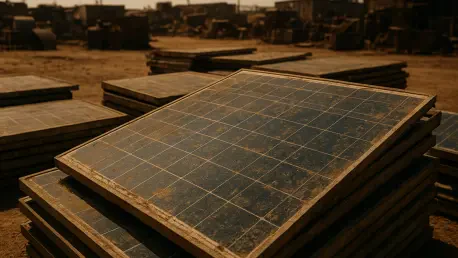

The global transition toward renewable energy has accelerated the installation of solar photovoltaic systems at an unprecedented rate, yet the industry now faces a paradoxical challenge regarding the lifecycle of these very technologies. As manufacturers strive to make solar power more competitive by stripping away expensive materials, they are inadvertently dismantling the economic foundation of the recycling industry that must eventually process this hardware. The reduction of high-value components such as silver and copper significantly diminishes the scrap value of decommissioned panels, creating a massive financial gap in the waste management chain. This trend is particularly concerning given the sheer volume of waste expected to hit the market in the coming years. Without a high concentration of recoverable precious metals, the labor-intensive process of dismantling and purifying solar glass and silicon becomes a loss-making venture for recovery firms that lack sufficient subsidies to operate successfully within the current market environment.
Economic Pressures on Material Recovery
Diminishing Returns in Modern Photovoltaic Design
The cost-out strategy employed by major manufacturers, particularly those dominating the market in Asia, has successfully lowered the barrier to entry for solar adoption but at a steep environmental cost for the backend. Professor Xavier Mulet from RMIT University and industry leaders like Simon Linge of Livium highlight that modern panel designs utilize significantly thinner layers of silver paste and copper wiring compared to older models. While this engineering feat allows for cheaper mass production, it fundamentally alters the chemistry of the waste stream that recyclers encounter. When silver content drops below a certain threshold, the energy required to extract and refine it often exceeds the market value of the reclaimed metal. This shift forces recycling companies to reconsider their business models, as they can no longer rely on commodity markets to subsidize the collection and processing of bulky modules. These advancements in manufacturing efficiency are effectively shifting the burden of cost to the end of the lifecycle.
Challenges in Commercial Viability and Scaling
The debate over the recoverable value of these materials has led to significant friction between academic researchers and on-the-ground recovery operators. While experts like Professor Mulet argue that the efficiency strategies used by major manufacturers have fundamentally gutted the value of the newest generation of panels, others like John Hill from Pan Pacific offer a more cautious perspective. Hill suggests that some panels currently entering the waste stream still contain silver levels comparable to legacy technology, providing a temporary lifeline for recycling plants. However, the reliance on such older inventory is a dwindling prospect as newer, material-thrifty panels begin to dominate the decommissioning cycle. Recyclers face a future where the resale of aluminum and copper might be the only consistent revenue driver, yet even these markets are subject to global price volatility. This economic uncertainty discourages the investment needed for automated processing lines that could handle high volumes more efficiently.
Strategic Responses and Policy Frameworks
Legislative Hurdles and Administrative Stagnation
The regulatory landscape has remained largely stagnant, further complicating the transition to a sustainable waste management system for the solar industry. A $25 million federal pilot program, designed to establish 100 strategic collection sites across the country, has stalled due to protracted legal disputes regarding the selection of a scheme administrator. This administrative bottleneck has left recycling companies in a state of distress, as they are unable to access the coordinated logistics or financial support promised by the initiative. The Department of Climate Change, Energy, the Environment and Water (DCCEEW) remains in a holding pattern, which prevents the implementation of a national framework for panel disposal. Without this oversight, the industry lacks a standardized approach to handle the diverse array of technologies entering the waste stream. The resulting uncertainty has prevented businesses from expanding their capacity to meet the growing demand for sustainable decommissioning services.
Establishing Long-Term Financial Stability
The findings of recent industry inquiries established that the solar sector reached a critical crossroads where technological efficiency and waste management reality collided. Stakeholders recognized that the ongoing reduction in precious metal content was an irreversible trend driven by the global demand for cheaper energy. To address this, leaders proposed a multi-faceted strategy focused on legislative reform and technological investment to ensure the long-term viability of the circular economy. The primary recommendation involved the immediate activation of the national stewardship scheme and the implementation of a consistent product fee to stabilize recycling revenue. Furthermore, the industry looked toward developing secondary markets for reclaimed glass and low-grade silicon to diversify income streams beyond precious metals. These actions provided a roadmap for transitioning from a volatile, commodity-dependent model to a structured, sustainable system. By decoupling recycling profitability from fluctuating metal prices, the sector ensured that waste would be handled with care.