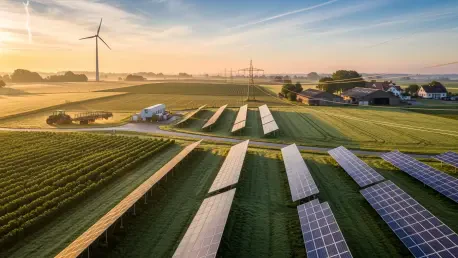

The sun-drenched landscapes of the American heartland, where the rhythmic hum of solar installation crews once signaled a new era of financial security, have recently fallen into an uneasy and prolonged silence. This abrupt transition from a flourishing renewable energy boom to a state of regulatory stagnation marks a pivotal moment for thousands of agricultural producers who had integrated solar panels into their long-term survival strategies. What was once heralded as a bipartisan solution to rural economic volatility has suddenly transformed into a complex web of administrative hurdles, leaving independent landowners caught between their need for sustainable income and a federal landscape that is rapidly withdrawing its support.
The Abrupt Cooling of Rural America’s Solar Boom
The sudden deceleration of federal energy support has sent shockwaves through the agricultural sector, where farmers had increasingly come to view solar arrays as a reliable “cash crop” that required no water and little maintenance. This shift in policy direction has fundamentally altered the landscape of rural development, replacing the optimism of green energy expansion with a pervasive sense of financial dread. For many, the transition was near-instantaneous; projects that were on the verge of breaking ground are now gathering dust as developers and landowners grapple with a new reality defined by bureaucratic pauses and shifting priorities.
Solar energy, which transitioned from an experimental niche to a mainstream financial lifeline over the past decade, is now a primary source of regulatory uncertainty for those who can least afford it. Independent operators, who often work on margins so thin that a single bad season can lead to foreclosure, had banked on these federal incentives to modernize their infrastructure or simply keep their land in the family. The current pivot has not just slowed the installation of hardware; it has undermined the trust between the federal government and the rural communities that were promised a seat at the table in the new energy economy.
For family farms, the significance of this policy shift cannot be overstated, as the loss of anticipated grants often means the difference between expansion and insolvency. The suspension of expected funds has created a domino effect, where canceled energy projects lead to broken contracts with local installers and a broader chilling of investment in rural infrastructure. This cooling effect is visible from the Northeast to the Pacific Northwest, suggesting that the era of aggressive rural solar expansion has been met with a formidable and intentional institutional roadblock.
The Historic Alliance Between Agriculture and Renewable Energy
The partnership between American agriculture and renewable energy is not a recent phenomenon, but rather a long-standing collaboration rooted in the Energy Policy Act of 2005. That landmark legislation established the Rural Energy for America Program (REAP), which for years enjoyed broad bipartisan support for its ability to lower utility costs for producers and small businesses. Over the decades, REAP became a cornerstone of rural policy, providing the necessary capital for farmers to transition toward more efficient irrigation systems and on-site power generation, effectively insulating them from the volatility of fossil fuel markets.
The momentum of rural solar was further supercharged by the landmark legislation of the early 2020s, which infused the sector with unprecedented capital and expanded the scope of what was possible for independent landowners. This era saw a significant rise in “agrivoltaics,” where solar panels and traditional farming coexist on the same plot of land, maximizing the productivity of every acre. For many, these investments represented more than just environmental stewardship; they were a pragmatic response to the increasing costs of traditional farming, offering a steady secondary income stream that could offset the rising prices of fertilizer and machinery.
Economic relevance is at the heart of this alliance, as solar leasing and energy efficiency have historically provided a crucial buffer against the cyclical nature of commodity prices. Landowners who participated in these programs were not just generating electricity; they were securing their own economic autonomy by diversifying their revenue. This historical context makes the current disruption even more jarring, as it reverses a multi-decade trend of increasing cooperation between the Department of Agriculture and the renewable energy industry, leaving a legacy of half-finished projects and unfulfilled promises.
Major Policy Shifts Disrupting the Rural Energy Landscape
A series of specific federal actions has recently converged to halt the progress of green energy initiatives within farming communities across the nation. These maneuvers range from the freezing of dedicated grant pools to the implementation of restrictive new timelines that make large-scale development nearly impossible to execute. The result is a fragmented landscape where the rules of engagement for energy production are being rewritten mid-stream, leaving both small-scale farmers and large developers in a state of perpetual limbo.
The Total Suspension of REAP Grant Allocations
Current data from the Department of Agriculture reveals a stark reality: for the current fiscal year, there has been a complete cessation of new grant awards under the REAP program. This total suspension has effectively stranded thousands of applications that were submitted in good faith by farmers who were counting on the 50 percent reimbursement previously offered for solar and efficiency upgrades. These projects, which range from small rooftop arrays on barns to complex geothermal systems, are now stalled indefinitely as the agency undergoes what it describes as a period of “programmatic updates.”
The impact of this freeze is particularly acute for those who had already entered into legal agreements with contractors based on the expectation of federal support. Analysis of the USDA’s internal tracking shows that the pipeline of rural energy funding has essentially dried up, creating a massive backlog of unvetted proposals. Without the certainty of these grants, many farmers are unable to secure the private financing needed to complete their projects, leading to a nationwide stall in small-scale rural energy production that may take years to rectify.
The Compressed Timeline for Investment Tax Credits
Compounding the loss of direct grants is the implementation of 2024 tax legislation that has radically altered the eligibility window for clean energy Investment Tax Credits (ITC). In a move that industry experts describe as a “reverse clock,” the new rules require projects to be fully operational by the end of 2027 to receive the maximum benefit. This compressed schedule is effectively a death sentence for approximately 20 gigawatts of potential solar power, as the typical lead time for permitting, interconnection studies, and construction often exceeds three to four years.
This legislative shift has forced developers to abandon projects that were already in the advanced stages of planning, as the risk of missing the operational deadline is too high to justify the capital expenditure. Large-scale solar arrays situated on agricultural land are especially vulnerable to these changes, as they often face complex local zoning challenges that are impossible to resolve within the newly mandated timeframe. Consequently, the dream of a decentralized, rural-led energy transition is being systematically dismantled by a calendar that favors speed over sustainability and thorough planning.
The Mandate for Ideological Revisionism in Applications
In addition to financial and temporal hurdles, there has been a notable shift in the language required for federal grant proposals. Applicants are now being encouraged to “voluntarily” scrub their proposals of any mention of climate change or initiatives related to diversity, equity, and inclusion to align with new executive directives. This requirement for ideological revisionism has created a bizarre situation where farmers must describe their renewable energy projects without referencing the very environmental goals that often drove their inception.
This shift in rhetoric is more than just a matter of semantics; it represents a fundamental change in how the government evaluates the value of rural energy projects. By prioritizing administrative alignment over technical merit or environmental impact, the process has become increasingly politicized. Farmers who were once praised for their role in the green transition are now navigating a system where the “wrong” word in a grant application can lead to an immediate rejection or an indefinite delay, further complicating an already arduous bureaucratic journey.
The Erosion of Economic Autonomy for Independent Farmers
The withdrawal of federal support for small-scale, farmer-owned energy assets is driving a concerning shift toward a reliance on large-scale corporate leasing. When independent operators are unable to secure the grants necessary to own their own solar infrastructure, they are often forced to lease their land to multinational energy corporations that have the capital to weather the current regulatory storm. This transition effectively moves the control of energy production out of the hands of the farmer and into the boardroom, eroding the very “energy freedom” that many rural landowners sought to achieve.
For many small-scale operators, the loss of federal subventions represents a forced trade-off: they must choose between survival and autonomy. While leasing land to a developer provides a steady check, it does not offer the long-term utility savings or the asset equity that comes with owning the equipment. Multinational developers, meanwhile, are better equipped to navigate the complex tax environment, meaning they can consolidate land and energy assets while individual farmers are relegated to the role of mere landlords. This power imbalance threatens to create a new form of corporate dependency in rural America, where the benefits of the sun are harvested by entities far removed from the soil.
Navigating a Fragmented Regulatory Environment
The current state of the rural energy market is best described as fragmented, with over 120 major solar projects currently stalled while awaiting various forms of regulatory approval. This bottleneck is not just a matter of slow paperwork; it is the result of a deliberate change in how federal agencies interact with energy developers and local communities. Major industry players have already begun pulling back, with some developers reporting millions in lost investment after concluding that the federal government’s new construction schedules are simply impossible to meet under current market conditions.
The Department of Agriculture has defended these actions as necessary for “program integrity,” but the reality on the ground is one of profound financial anxiety. From New York to Kentucky, farmers who had integrated solar into their retirement or succession plans are finding that the rules of the game have changed without warning. As developers abandon projects, the infrastructure that would have supported local tax bases and provided cheaper electricity for rural businesses remains unbuilt, leaving the American heartland to grapple with the consequences of a policy environment that appears increasingly hostile to decentralized renewable power.
Reflection and Broader Impacts
The shift from a bipartisan, pragmatic approach to rural energy toward a more politicized and restrictive model has created a lasting impact on the stability of the agricultural sector. What was once a clear path to modernization and financial security for farmers has become a battleground for competing visions of the nation’s energy future. This volatility has not only halted physical projects but has also stunted the growth of a specialized rural workforce that had begun to emerge around the renewable energy industry.
Reflection
The breakdown of the historical consensus on programs like REAP highlights a broader trend where even the most practical rural assistance can become a casualty of political maneuvering. Individual farmers, particularly those in states like Iowa and Texas where wind and solar have become integral to the economy, now face a future where federal support is no longer a given. The stress placed on these landowners is immense, as they must navigate a system that seems to prioritize ideological alignment over the day-to-day financial realities of modern farming, turning what should be a technical grant process into a test of political loyalty.
Broader Impact
The long-term implications of these policy shifts point toward a significant consolidation of the energy market. As tax credits become harder to secure and grants disappear, only the largest corporations with the most robust legal and financial departments will be able to survive. This could lead to a landscape where the transition toward a decentralized energy grid—once seen as a way to empower rural communities—is replaced by a centralized model that mirrors the traditional utility structures of the past. The loss of diverse, small-holder energy production may ultimately result in a grid that is less resilient and a rural economy that remains dangerously dependent on outside interests.
Securing the Future of the American Farmstead
The collective impact of frozen funds, shortened tax credit windows, and an ideological shift at the USDA has fundamentally reshaped the prospects for solar energy on the American farmstead. This period of federal volatility has proven to be the single greatest hurdle to rural prosperity, overshadowing even the market fluctuations that farmers are traditionally used to managing. While the resilience of the agricultural community is legendary, the current environment places an undue burden on those who are simply trying to maintain their heritage and protect their families’ economic futures.
The path forward for rural America depends heavily on the return of policy stability and a commitment to the practical needs of the independent producer. As the deadlines for the current tax credits approach, it is clear that many potential benefits of the rural energy boom were lost during this era of administrative friction. Moving forward, the focus must shift toward creating a regulatory framework that values the long-term health of the farmstead over short-term political objectives, ensuring that the next generation of farmers can once again look to the sun as a partner in their success. The lessons learned during this period of stagnation underscored the reality that for rural development to truly thrive, the rules governing its growth must remain as steady and reliable as the land itself.