
Hydraulic engineers have replaced the thin, straight leading edges of conventional turbine runners with thick, slanted, and forward-swept blades to prioritize ecological safety. This fundamental shift in mechanical design addresses one of the most persistent challenges in the transition to renewable energy: the lethal impact of hydropower infrastructure on river ecosystems. While hydroelectric dams remain a cornerstone of carbon-free electricity, the rotating components within them have historically acted as violent obstacles for migratory aquatic life. Recent experiments conducted at a sophisticated hydraulic test facility in Alameda, California, have demonstrated that changing the physical geometry of these runners can nearly eliminate the mortality rates that have plagued the industry for decades. By focusing on the intersection of fluid mechanics and biological preservation, researchers are proving that energy efficiency does not have to come at the expense of biodiversity in 2026.
Engineering a Biological Safeguard
Redirecting Physical Forces: Blunt Geometry
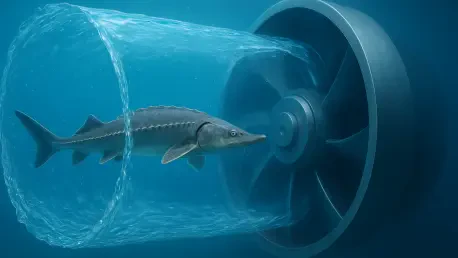
The core of this technological leap lies in a radical departure from the traditional “cutting” philosophy that dominated turbine engineering for over a century. Standard runners were historically designed with sharp, straight blades to maximize water throughput and minimize turbulence, effectively acting like high-speed underwater saws. In contrast, the newly developed slanted runner utilizes a geometry that mimics a blunt, padded wedge. This specific shape is engineered to convert a potential collision into a controlled deflection, significantly reducing the force of impact. When a fish enters the turbine housing, the forward-swept design ensures that the leading edge meets the organism at an oblique angle. This structural modification is not merely an aesthetic change but a calculated effort to manipulate the physical interaction between steel and flesh, ensuring that the kinetic energy of the spinning runner is dissipated safely rather than concentrated into a lethal strike.
Harnessing Fluid Dynamics: Contactless Safety
Beyond the physical shape of the blades, the new design leverages advanced fluid dynamics to create a protective cushion of water. High-speed video analysis from the 2026 trials revealed that the thick, slanted edges alter the pressure field immediately preceding the blade. This phenomenon creates a high-pressure zone that acts as a contactless barrier, often pushing the fish away from the metal surface before any physical touch occurs. The integration of these forward-swept components allows for the maintenance of high hydraulic efficiency while providing a clear pathway for aquatic life. By optimizing the water flow patterns around the runner, engineers have successfully reduced the frequency of direct strikes. This dual-purpose design ensures that the turbine functions as both a power generator and a biological bypass, representing a significant evolution in how industrial equipment is synchronized with natural environments to prevent the blunt-force trauma common in older systems.
Simulating Dam Environments: Juvenile Sturgeon
To ensure the reliability of these findings, the experimental protocol involved subjecting juvenile sturgeon to conditions that mirror the most demanding hydropower environments. These fish, ranging from four to eight inches in length, were passed through the turbine at tip speeds varying from 49 to 91 feet per second. The upper end of this spectrum, roughly equivalent to 62 miles per hour, represents the extreme highway speeds found in massive commercial dams. Researchers established a rigorous baseline by using a control group of fish that underwent all handling and transport procedures without entering the turbine itself. This method allowed the team to isolate the specific effects of the blade geometry from other stressors like water temperature or pressure changes. By focusing on sturgeon—a species particularly vulnerable to mechanical trauma—the study provided a worst-case scenario test for the new runner’s protective capabilities.
Evaluating Performance: High Operational Speeds
The results from these high-velocity tests offered a comprehensive look at the physical limits of survival during rapid transit. Even at the maximum speed of 91 feet per second, where traditional turbines typically show devastating mortality rates, the redesigned slanted runner maintained structural integrity and biological safety. The trial data emphasized that the resilience of the fish was not a matter of chance but a direct result of the reduced shear forces and minimized strike severity provided by the new geometry. By observing how fish bodies reacted to the intense pressure and turbulence within the housing, the engineering team gained insights into the durability of various species under duress. These trials demonstrated that the design remains effective even as water volume and velocity increase to meet peak energy demands. This level of testing rigor was essential for gaining the trust of utility operators who must balance biological safety with operational stability.
Environmental Standards: Redefining the Energy Landscape
Analyzing Success: Quantitative Design Outcomes
The quantitative outcomes of the California study represent a paradigm shift in the documented relationship between hydropower and ecology. While older turbine models often reported survival rates as low as 42% depending on the species and flow conditions, the slanted runner achieved a perfect 100% immediate survival rate across all experimental trials. Long-term monitoring over a 48-hour period further confirmed these results, with cumulative survival holding steady at 99.1%. Even at the highest tested velocities, the survival rate only experienced a negligible dip to 95.6%, a figure that remains vastly superior to any previous industrial standard. These statistics indicate that the lethal gamble for migratory fish has been largely removed through mechanical intervention. This data provides a robust foundation for utility companies looking to modernize their infrastructure without facing the heavy penalties or operational shutdowns often triggered by high fish mortality counts.
Projecting Survival: Multi-Axle Systems
Furthermore, the study utilized complex modeling to predict survival across multi-dam systems, which is critical for species migrating over hundreds of miles. In these multi-axle passage simulations, the slanted runner maintained a projected survival rate of 99.4%, making it statistically indistinguishable from the control group that never encountered a turbine. This level of safety is unprecedented, as it suggests that a fish could pass through several consecutive powerhouses without sustaining cumulative or fatal injuries. By neutralizing the physical threat at the source, the design eliminates the need for expensive and often inefficient diversion screens or bypass pipes that can disrupt natural migration patterns. The statistical parity between the turbine-exposed group and the control group proves that the mechanical trauma previously associated with dam passage is no longer an inherent feature of hydroelectric power, but rather a solved engineering problem that can be addressed through strategic retrofitting.
Navigating Hurdles: Licensing and Regulation
The success of this slanted blade design arrived at a critical juncture for federal energy licensing and environmental compliance. Current regulations in the United States and abroad increasingly mandate that hydroelectric operators prove safe downstream passage for protected species as a condition for long-term permits. This mechanical breakthrough provided a viable path for the continued operation of dams in ecologically sensitive zones where salmon, eels, and sturgeon are prevalent. Because the technology achieved high survival rates for multiple species beyond the initial sturgeon focus, it opened the door for a broader application across diverse river basins. The ability to integrate such safety features directly into the power-generating equipment allowed regulatory bodies to reconsider the environmental impact assessments of large-scale hydropower. This shift in perspective is expected to accelerate the relicensing process for many facilities, ensuring the 2026 energy portfolio remains reliable.
Implementing Solutions: River Biodiversity Goals
The transition toward slanted turbine geometry established a new benchmark for how renewable energy systems interacted with the natural world. Engineers and policymakers recognized that the previous era of hydropower development had frequently overlooked the biological costs of energy production, leading to a focus on retrofitting existing dams with this validated technology. This approach moved beyond mere observation and toward the active implementation of fish-safe runners as a standard requirement for all future upgrades and new installations. Industry leaders began collaborating with conservationists to map out the most critical migration corridors for immediate deployment, ensuring that biodiversity preservation was treated as a core performance metric. By prioritizing these mechanical adjustments, the hydropower sector effectively reconciled the demands of the power grid with the health of aquatic ecosystems. These advancements ensured that the survival of migratory species became a predictable outcome of design.