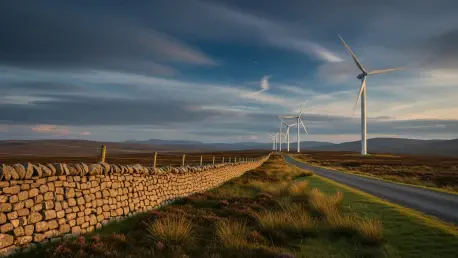

The transformation of the Scottish Highlands into a powerhouse of renewable energy has created a striking economic paradox where 21st-century technology is fueling a wealth transfer rooted in medieval land tenure. As the nation aggressively pursues its decarbonization targets, the infrastructure of the future is being built upon a foundation of concentrated private ownership that ensures a significant portion of public investment is diverted into the pockets of a few. This intersection of environmental progress and historical inequality has sparked a growing debate about who truly benefits from the green revolution. While wind turbines symbolize a cleaner future, the financial mechanisms supporting them are currently reinforcing a social structure where the many subsidize the extraordinary gains of the landed elite, raising fundamental questions about the fairness of the modern energy economy.
The Massive Disparity in Financial Benefits
Analyzing the Rent and Community Wealth Gap
The financial landscape of the Scottish onshore wind sector is defined by a staggering imbalance between the revenues captured by private estates and the funds allocated for the local public good. Investigative data from current projects reveals that the rental income paid to a single landowner often dwarfs the total “community benefit” payments provided to the entire surrounding population. At the Dorenell Windfarm in Moray, for example, the landowner received approximately £11 million in rental income during a single year of operation, while the local community received just under £465,000. This twenty-three-fold difference is not an isolated anomaly but rather a systemic feature of the industry. These disparities suggest that while the physical presence of wind farms impacts entire regions, the financial rewards are largely sequestered by those who hold title to the soil, leaving local residents with a comparatively meager share of the prosperity generated in their own backyards.
This economic gap is further widened by the structure of modern energy subsidies, specifically the United Kingdom’s Contracts for Difference (CfD) scheme. Funded by levies on household energy bills, these subsidies provide wind farm developers with a guaranteed price for the electricity they generate, ensuring long-term financial stability for large-scale projects. However, because land lease agreements are frequently structured as a percentage of the wind farm’s total turnover, landowners effectively receive a direct pass-through of this public money. When energy prices fluctuate or when production is particularly high, the landowner’s rent increases proportionally with the subsidy-backed revenue. In contrast, community benefit payments are typically fixed at a set rate per megawatt or linked to inflation at a much lower trajectory. Consequently, the public is indirectly financing a massive accumulation of private wealth that grows in tandem with the state’s commitment to renewable energy.
The Divergent Paths of Private and Public Revenue
The mechanics of land leasing in the renewable sector have created a scenario where private estates operate as high-yield “power plants” without the owners needing to contribute labor or capital to the energy transition. Unlike the developers who take on the technical and financial risks of construction, or the local communities who host the visual and environmental impact of the turbines, landowners extract “economic rent” simply by granting access to a finite natural resource. This rent extraction is increasingly seen as a barrier to the “just transition” promised by policymakers. While the Scottish Government encourages a “good neighbor” policy regarding community benefits, these payments remain entirely voluntary and lack the legal teeth required to compete with the binding commercial contracts held by landowners. The result is a dual-track economy where the elite profit from the scarcity of land while the public receives what amounts to a charitable donation.
Furthermore, the transparency of these financial arrangements remains a significant hurdle for public accountability and reform efforts. Many lease agreements are protected by commercial confidentiality, making it difficult for the public to understand the true scale of the wealth transfer occurring through their energy bills. Without standardized reporting requirements, the extent of the disparity only comes to light through intensive investigative reporting. This lack of transparency allows the current system to persist without significant pushback, as the “hidden” cost of land rent is baked into the overall price of energy. As the industry matures, the tension between the private right to profit from natural resources and the public right to an affordable energy transition continues to intensify, suggesting that the current model of community benefits is insufficient to address the underlying structural inequalities of the Scottish land market.
Structural Inequality and Land Concentration
The Monopoly on Renewable Energy Resources
The geographic reality of Scotland’s renewable energy boom is inextricably linked to one of the most concentrated patterns of land ownership in the developed world. Currently, a mere 400 individuals and entities control half of all privately held rural land in the country, creating a natural monopoly over the sites most suitable for large-scale wind development. This concentration provides a small group of owners with immense leverage over both the government and energy developers, as there are limited alternatives for the placement of high-yield turbines. This “bottleneck” effect allows landowners to demand premium prices for leases, knowing that the national drive toward net-zero emissions makes their land an indispensable asset. Instead of a competitive market that could drive down costs for the consumer, the Scottish land system facilitates a scenario where a tiny fraction of the population can dictate the terms of the green energy revolution.
The beneficiaries of this concentrated control represent a fascinating blend of old-world status and new-world financial ambition. Hereditary aristocrats, such as the Earls of Home and the 7th Earl Cawdor, have successfully transitioned their ancestral holdings from traditional agriculture and forestry into modern energy hubs. These families, whose control over the Scottish landscape spans centuries, are now leveraging their historical position to capture the subsidies of the future. By repurposing their estates for wind power, they have ensured that their family legacies remain financially viable in the 21st century. This continuity of wealth reinforces long-standing class structures, as the same families that dominated the agrarian and industrial eras are now positioning themselves as the gatekeepers of the renewable era, effectively modernizing the feudal concept of land-based power through the lens of green technology.
Global Capital and the New Green Lairds
The high-yield potential of Scottish wind power has also attracted a new class of “green lairds” consisting of international aristocrats, high-net-worth financiers, and institutional investors. Figures like the Anglo-Irish financier Christopher Moran and the Swedish nobleman Baron Johan Koskull have acquired or managed vast tracts of land specifically to capitalize on the lucrative leasing opportunities provided by the wind sector. These individuals often have little to no historic connection to the regions they own, viewing the Scottish landscape primarily as a financial asset or a hedge against market volatility. This shift toward international and institutional ownership further detaches the profits of the energy transition from the local economy. When a wind farm generates millions in rent for an overseas investor or a London-based asset management firm, that wealth leaves the local community entirely, providing no secondary economic boost to the region.
Institutional players like Gresham House, which has rapidly become one of Scotland’s largest private landowners, exemplify the corporatization of the Highlands. These firms manage land on behalf of pension funds and private clients, seeking stable, long-term returns that are uncorrelated with traditional stock markets. Because wind energy leases are typically signed for 25 to 30 years and are backed by government-guaranteed subsidies, they represent the ultimate “safe haven” for capital. However, this trend toward institutionalization makes land reform even more complex, as the owners are no longer local individuals who might be swayed by community pressure, but rather faceless entities bound by a fiduciary duty to maximize returns for their shareholders. This evolution of landownership suggests that without significant policy intervention, the Scottish wind boom will continue to serve as a mechanism for global wealth concentration rather than a tool for regional revitalization.
Barriers to a Fair Energy Transition
Economic Obstacles and Market Pressures
Landowner representative groups often argue that the high rents associated with wind farms are a necessary and fair compensation for the long-term “sterilization” of the land. Under this perspective, the installation of massive turbine foundations, access roads, and electrical infrastructure effectively prevents the land from being used for traditional purposes like farming, timber production, or sporting for several decades. They contend that any entity—whether a private individual or a community trust—entering into such a restrictive, multi-decade contract deserves to be compensated for the loss of alternative opportunities. However, this argument often fails to account for the fact that wind energy is significantly more profitable than the activities it replaces. The transition from sheep farming or forestry to power generation is not merely a replacement of one industry with another; it is a massive upgrade in the land’s earning potential, yet the benefits of this upgrade remain almost exclusively with the title holder.
This market-driven approach to land valuation creates an inherent conflict with the public goal of reducing energy costs. Because developers must pay high rents to secure sites, these costs are ultimately passed on to the consumer through higher strike prices in the CfD auctions. There is currently no mechanism within the Scottish planning or energy system to cap land rents or to ensure that a portion of the “scarcity value” is returned to the public purse. Instead, the “market rate” for land is determined by the highest possible price a developer is willing to pay to beat out a competitor. This creates an upward spiral of land costs that keeps energy prices higher than they would be in a more equitable system. The lack of a regulatory ceiling on what a landowner can extract from a subsidized project means that the transition to green energy is unnecessarily expensive for the average citizen.
Public Land and the Price of State Participation
Even state-owned entities in Scotland are currently caught in the trap of market-based pricing, limiting their ability to act as a corrective force in the energy market. Forestry and Land Scotland (FLS), which manages about 14% of the nation’s onshore wind capacity, is legally mandated to seek “best value” for the taxpayer in all its commercial dealings. In practice, this has been interpreted as charging market rates for wind leases that are comparable to those sought by private estates. While the revenue generated by FLS is reinvested into public services and land management, the organization’s adherence to private-sector pricing prevents it from using its vast holdings to drive down the overall cost of land for the industry. By matching the prices set by the landed gentry, the state-owned body inadvertently helps to validate and maintain the high-rent environment that characterizes the Scottish Highlands.
This situation presents a significant policy dilemma for the Scottish Government. If FLS were to offer land at lower rates to encourage more affordable energy production, it could be accused of failing its “best value” mandate or distorting the market. However, by continuing to follow the lead of private landowners, the state is missing an opportunity to demonstrate an alternative model of resource management. Critics argue that the government should redefine “best value” to include the social and economic benefits of lower energy prices for all citizens, rather than just the direct revenue generated from a lease. Without a shift in how public land is utilized, the state remains a participant in a high-cost system rather than a leader in a more equitable one. This highlights the need for a broader strategic rethink of how public assets can be leveraged to ensure that the green transition truly serves the collective interest.
Pathways Toward Systemic Reform
Community Ownership and Policy Alternatives
The most frequently proposed solution to the current wealth disparity is a radical shift toward community land ownership. Advocates argue that if local populations owned the land where wind farms are built, the millions of pounds currently flowing to private estates could instead be used to fund local schools, healthcare, housing, and infrastructure. Currently, less than 3% of Scottish land is under community ownership, leaving the vast majority of rural populations at the mercy of private landlords. By acquiring the land, communities would not only receive the voluntary benefit payments but would also capture the full rental and equity value of the energy projects. This would transform renewable energy from an extractive industry into a foundational pillar of local economic resilience, allowing communities to become self-sustaining and less dependent on centralized government funding or the “charity” of billionaire landowners.
To make this transition a reality, significant policy changes would be required to overcome the financial and legal barriers that currently prevent community buyouts. Reforming the Scottish Land Fund to provide more substantial support for large-scale acquisitions and introducing a “right to buy” for renewable energy purposes could empower local groups to take control of their resources. Additionally, some suggest that the planning process should be amended to favor projects with high levels of local or public ownership. By making community participation a requirement for planning approval rather than a recommended “good neighbor” gesture, the government could shift the balance of power away from absentee landlords. This approach would ensure that the long-term value of Scotland’s natural assets remains within the country, fostering a new generation of local entrepreneurs and stakeholders who are directly invested in the success of the green economy.
Redefining the Just Transition for a Fairer Future
The ultimate challenge for Scotland as it moves deeper into the 21st century is whether it can reconcile its ambitious climate goals with its antiquated land tenure system. The current model, where the public pays twice—once through subsidies and again through high land rents—is increasingly viewed as unsustainable and socially unjust. To achieve a truly “just transition,” the government must move beyond carbon reduction targets and address the underlying distribution of wealth. This might involve the introduction of a Land Value Tax specifically targeted at large-scale energy sites or the creation of a national energy company that prioritizes public and community benefit over private profit. Such measures would ensure that the wind, which is a public resource, does not simply become a new way to enrich a historically privileged class at the expense of the modern bill-payer.
In conclusion, the investigation into the financial dynamics of the Scottish wind sector demonstrated that the green revolution has been significantly hampered by a land system that prioritizes private rent extraction over public prosperity. The evidence showed an extreme disparity between landowner profits and community benefits, facilitated by a concentrated monopoly on viable sites and supported by taxpayer-funded subsidies. Moving forward, the focus must shift toward structural land reform and the expansion of community ownership to ensure that the wealth generated by Scotland’s natural resources is shared more equitably. Policymakers should consider implementing mandatory benefit levels and reevaluating the mandates of public bodies to prioritize energy affordability. By taking these actionable steps, the nation can ensure that the transition to renewable energy serves as a catalyst for social justice and long-term economic stability for all its citizens.