
Italy finds itself at a critical crossroads where the sheer volume of municipal waste generated by its urban centers threatens to outpace the current capacity of its recycling infrastructure. While the nation has historically outperformed many of its European counterparts in terms of recycling rates for specific materials like paper and glass, the total waste production has continued to climb steadily as consumption patterns evolve. This paradox of rising efficiency alongside increasing waste necessitates a fundamental shift in how the country views its garbage, moving beyond simple disposal toward a sophisticated model of resource recovery. The urgency of this situation is underscored by the European Union’s targets for the circular economy, which demand that member states significantly reduce landfill use while maximizing the extraction of raw materials. Navigating this transition requires more than just updated policies; it demands a reimagining of the industrial landscape.
Bridging the Divide: Infrastructure Disparities and National Policy
The geographical landscape of waste management in Italy reveals a stark contrast between the northern and southern regions, creating a fragmented system that hampers national progress. In the north, high-capacity waste-to-energy plants and advanced biological treatment facilities have largely eliminated the reliance on landfills, turning refuse into a valuable source of electricity and heat for local communities. Conversely, many southern municipalities continue to struggle with inadequate infrastructure, often relying on the long-distance transport of waste to other regions for processing. This logistical bottleneck not only inflates costs for taxpayers but also increases the carbon footprint associated with waste handling across the peninsula. Bridging this gap has become a primary focus for national planners, who recognize that a circular economy cannot exist if half the country lacks the tools to participate. Investment in localized treatment centers is essential to creating a cohesive network.
Addressing these regional imbalances requires a strategic deployment of capital, particularly through the utilization of European recovery funds earmarked for ecological transition. These financial resources are being directed toward the construction of new organic waste treatment plants and the modernization of existing sorting centers to improve the purity of recovered materials. By standardizing the quality of recycled outputs, Italy aims to provide its manufacturing sector with a reliable supply of secondary raw materials, reducing the dependence on imported resources. The integration of digital tracking systems also plays a vital role in this transformation, allowing authorities to monitor waste flows in real-time and identify areas where collection efficiency can be improved. This data-driven approach ensures that investments are made where they are most needed, fostering a more equitable distribution of environmental benefits. Decentralized processing empowers local administrations.
Future Pathways: Industrial Innovation and Systemic Change
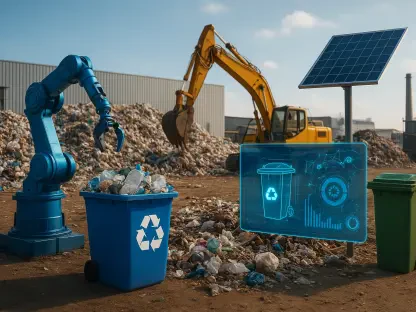
Beyond the expansion of physical infrastructure, the Italian waste sector is undergoing a technological revolution aimed at extracting higher value from complex waste streams. Innovative sorting technologies, such as hyperspectral imaging and AI-driven robotics, are now being deployed to identify and separate plastics that were previously considered unrecyclable. These advancements are particularly significant for Italy’s robust textile and fashion industries, which are under pressure to address the environmental impact of their production cycles. New chemical recycling methods are being developed to break down mixed fibers back into their original monomers, allowing for the creation of high-quality yarns without the degradation typical of mechanical recycling. This focus on “upcycling” ensures that waste is not merely diverted from landfills but is actively reintegrated into the production of core goods. The innovations position the nation as a global leader in circular manufacturing.
Stakeholders recognized that the path to a balanced waste management system required more than just technical fixes; it demanded a systemic overhaul of consumer behavior and industrial design. Legislative bodies enacted stricter regulations on single-use packaging while incentivizing manufacturers to adopt eco-design principles that prioritized repairability and recyclability. This shift moved the burden of responsibility from municipalities to the producers of goods, fostering a market for durable products that remained in the economic loop for longer periods. Local authorities also implemented more granular collection schemes that successfully increased the purity of the waste collected at the source, making subsequent recovery processes more efficient. These actions established a blueprint for other nations to follow, proving that economic vitality and resource stewardship were not mutually exclusive but rather interconnected components of a modern industrial strategy.