
The landscape of the American energy sector is currently witnessing a profound structural shift as the cost profiles for different tiers of battery storage technology move in starkly opposite directions. While massive grid-scale installations benefit from an unprecedented collapse in pricing, smaller community-level and distribution-scale projects are finding themselves caught in a period of relative stagnation. This divergence marks a significant departure from previous years when the entire storage market generally moved in lockstep with global commodity trends. The current situation is largely defined by a strategic pivot among major equipment manufacturers who are increasingly funneling their limited engineering resources and production capacities toward massive utility contracts. These high-capacity systems are essential for powering the burgeoning network of data centers and meeting the requirements of independent power producers who are racing to stabilize the national grid amidst rising demand.
Supplier Priorities and the Utility Advantage
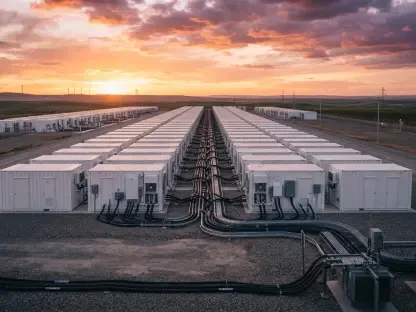
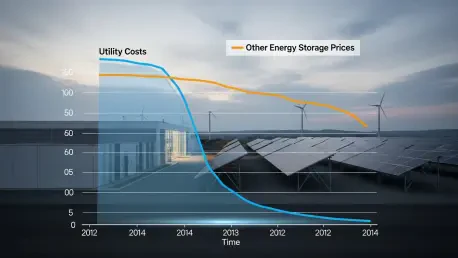
Manufacturers have fundamentally recalibrated their business models to prioritize utility-scale ventures, which has led to a dramatic 20.9% reduction in costs for these large systems since May of the previous year. This precipitous drop is not merely a reflection of cheaper raw materials but also an indicator of the intense competition among suppliers to secure anchor positions in multi-gigawatt portfolios. By focusing on these high-volume orders, battery producers can streamline their logistics and manufacturing pipelines, passing the resulting efficiency gains directly to large-scale developers. This concentration of effort has effectively transformed the utility segment into a primary driver of the energy transition, leaving smaller distribution-scale projects to operate in a secondary market. For these larger players, the economics of scale have never been more favorable, as the sheer magnitude of their procurement allows them to dictate terms that smaller entities simply cannot match in the current climate.
In contrast to the rapid decline in utility-scale pricing, distribution-scale systems have seen their costs flatten significantly, reaching a state of equilibrium that has persisted since late last year. Current benchmarks show that alternating-current configurations are hovering around $203 per kilowatt-hour, while direct-current setups remain steady at approximately $175 per kilowatt-hour. While these figures represent an improvement compared to historical highs, the lack of recent downward movement suggests that supply conditions are tightening for projects that do not meet the massive scale requirements of top-tier manufacturers. This stagnation occurs because suppliers are often unwilling to disrupt their high-throughput production lines for the more complex and varied requirements of smaller distribution projects. Consequently, developers in the community solar and microgrid spaces must navigate a landscape where their bargaining power is diminished, and their project timelines are increasingly sensitive to global supply chains.
Domestic Manufacturing and Policy Influences
The U.S. energy landscape is bracing for a wave of new supply as thirteen domestic battery cell manufacturing facilities are scheduled to commence operations between mid-2026 and mid-2027. This expansion of the local industrial base is intended to reduce the industry’s reliance on foreign supply chains and provide a more stable pricing environment for all market segments. The infusion of domestically produced cells is expected to alleviate some of the upward pressure currently exerted by rising lithium carbonate costs and the reduction of value-added tax rebates in international markets. Furthermore, the Treasury Department has provided much-needed clarity regarding Foreign Entity of Concern rules, which has enabled many developers to confidently claim the 30% federal investment tax credit. By meeting specific material sourcing requirements, these projects can achieve a level of financial viability that offsets the logistical challenges associated with transitioning to a domestic-first procurement strategy for critical energy components.
However, the path toward a fully localized supply chain is fraught with significant geopolitical and trade policy risks that could undermine recent economic gains. Industry analysts are closely monitoring the potential for national security tariffs and a possible 100% levy on Chinese active anode materials, which remain a staple in current battery chemistries. Additionally, there are ongoing discussions regarding potential legislative bans on foreign-made inverters, a move that would necessitate a rapid and costly shift toward domestic alternatives. These trade uncertainties create a volatile outlook, as any sudden increase in the cost of imported materials could easily negate the savings provided by federal incentives and local production efficiencies. For project developers, this means that while the headline costs of utility storage are currently falling, the long-term risk profile remains elevated due to the unpredictable nature of international trade regulations and the evolving definition of energy security in a polarized global economy.
Strategic Adaptations for Future Market Stability
To navigate this bifurcated market, developers are increasingly adopting sophisticated procurement strategies that prioritize long-term supply agreements and flexible project designs. By securing capacity early in the development cycle, companies can insulate themselves from the immediate effects of price volatility and ensure that their projects remain on track despite the prioritizing of utility-scale orders by major manufacturers. This proactive approach also involves exploring alternative battery chemistries and non-lithium technologies that may not be subject to the same geopolitical pressures as traditional lithium-ion systems. As the market matures throughout 2026 and into 2027, the ability to diversify technology choices will become a critical differentiator for firms seeking to maintain profitability in the distribution-scale segment. Moreover, the integration of advanced energy management software is allowing operators to extract more value from existing assets, lowering the total cost of ownership.
The transition toward a more resilient energy storage ecosystem required a concerted effort from both private enterprise and public policy to align economic incentives with grid stability goals. Stakeholders successfully identified that the divergence in pricing was not a permanent fixture but a transitional phase as the domestic manufacturing base scaled up to meet unprecedented demand. The focus shifted toward standardizing components for distribution-scale projects, which allowed smaller developers to benefit from some of the modularity and manufacturing efficiencies previously reserved for utility-scale giants. By the end of this cycle, the industry had moved closer to a model where price stability was driven by technological innovation and robust local competition rather than fluctuating global commodity prices or trade disputes. These steps ensured that the momentum gained from record-breaking installations in previous years was maintained, providing a foundation for a more sustainable and predictable storage market.