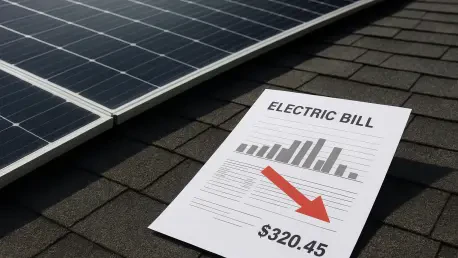

The promise of renewable energy often clashes with the reality of utility billing structures in California, where many homeowners find themselves paying hundreds of dollars monthly despite the presence of rooftop solar panels. This specific paradox is frequently observed in residences built around five years ago, where developers installed minimal solar arrays solely to satisfy state regulatory requirements rather than to accommodate the actual energy footprint of a modern household. A typical example involves a Southern California property equipped with a ten-panel system that generates enough power to meet only a fraction of the daily demand, resulting in monthly utility bills ranging from $350 to $400. These “check-the-box” installations often lack battery storage, forcing residents to rely heavily on the grid during peak evening hours when electricity rates are at their highest. Consequently, the initial financial appeal of a solar-ready home evaporates as high consumption outpaces output.
Regulatory Constraints: The Impact of Legacy Billing Status
A significant hurdle for residents seeking to resolve these high costs is the complex evolution of Net Energy Metering policies, which dictate how much credit a homeowner receives for excess energy sent back to the grid. Many people who purchased homes between 2026 and 2028 are currently grandfathered into the NEM 2.0 structure, which offers much more favorable export rates than the newer NEM 3.0 framework. Under the older rules, the value of electricity sent to the utility is nearly equal to the retail rate, making the grid act as a cost-effective virtual battery. However, any substantial modification to an existing solar array, typically defined as an increase in capacity of more than ten percent or one kilowatt, triggers a mandatory transition to the NEM 3.0 system. This newer policy significantly slashes export credits, sometimes by as much as seventy-five percent, which can paradoxically lead to higher overall costs even if more panels are added to the roof.
Strategic Expansion: Risks of Power Purchase Agreements
Due to these regulatory constraints, industry experts often advise against large-scale system expansions that would forfeit legacy billing status, recommending instead that homeowners pursue modest upgrades. Adding a small number of panels, perhaps four to six units, can sometimes provide just enough extra energy to offset peak usage without exceeding the threshold that would force a move to the less profitable net billing tariff. Furthermore, there is a growing consensus that homeowners should be wary of long-term Power Purchase Agreements that include annual price escalators, as these contracts often become significant liabilities during the home resale process. Potential buyers are frequently reluctant to assume decades of financial obligations tied to a system they do not own, especially when the contract terms may eventually exceed the cost of grid power. Maintaining ownership of the hardware and preserving the NEM 2.0 status remains the most strategically sound approach for any homeowner.
Technological Solutions: The Integration of Battery Storage
As the limitations of undersized solar arrays become more apparent, battery storage has emerged as a critical technological bridge for homeowners looking to reclaim their energy independence without altering their regulatory standing. By integrating a storage solution, a household can capture excess solar energy generated during the sunny afternoon hours and deploy it during the expensive on-peak periods in the evening. This strategy, often referred to as self-consumption or load shifting, is particularly effective because it bypasses the need to export energy at low credit rates only to buy it back later at a premium. Modern lithium iron phosphate batteries offer the durability and safety required for residential use, allowing for thousands of cycles over many years of operation. Implementing a battery-first approach provides a way to mitigate high utility bills that is entirely independent of the size of the solar array, as the focus shifts to using energy more intelligently in 2026.
Market Tools: Utilizing Data for Energy Efficiency
To navigate these technical and financial decisions, homeowners are increasingly utilizing sophisticated comparison tools and digital platforms to evaluate their options without the pressure of aggressive sales tactics. Resources like EnergySage allow users to compare multiple quotes for battery retrofits and panel expansions, ensuring that any chosen solution is right-sized for their specific consumption patterns and architectural constraints. These platforms also help in identifying state-level incentives or federal tax credits that can significantly offset the upfront costs of adding storage or high-efficiency components. By analyzing historical usage data and local utility rate schedules, homeowners can determine the exact point of diminishing returns for any proposed upgrade. The overarching goal has shifted from simply installing hardware to creating a holistic energy management system that balances production, storage, and consumption. This data-driven approach ensures that all long-term investments remain fully protected.
Strategic Evolution: The Shift Toward Energy Independence
The transition toward more robust energy management systems proved essential for residents who initially struggled with the shortcomings of builder-installed solar arrays. Homeowners successfully moved away from a passive reliance on the grid by adopting integrated storage solutions that allowed for greater control over their domestic electricity usage. This shift enabled households to maintain their favorable regulatory status while simultaneously reducing their dependence on high-cost utility power during peak hours. Those who prioritized ownership of their equipment and avoided predatory leasing agreements found themselves in a much stronger position when it came time to sell their properties, as buyers valued the combination of low bills and modern technology. Ultimately, the integration of smart home monitoring and localized storage became the standard for achieving true energy independence in a fluctuating economic landscape. This strategy addressed the financial strain of the past and established a foundation for sustainable use.