
Introduction
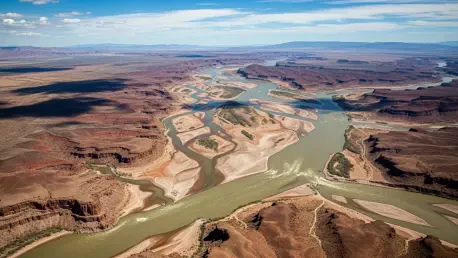
The relentless progression of an unprecedented megadrought across the Western United States has finally pushed the Colorado River Basin to a tipping point where traditional water management no longer suffices to prevent a total energy collapse. Decades of aridification, exacerbated by shifting climate patterns, have forced federal officials into a period of emergency triage that prioritizes the stability of the electrical grid over long-standing recreational and ecological norms. This shift represents more than just a seasonal adjustment; it is a fundamental realignment of how the nation manages its most over-allocated river system.
The objective of this exploration is to dissect the radical strategies currently being employed by the U.S. Bureau of Reclamation to maintain power generation at critical infrastructure points. By examining the logistical “robbing Peter to pay Paul” approach, this analysis clarifies the trade-offs required to keep turbines spinning and the economic ripple effects felt by millions of residents. Readers can expect to learn about the specific thresholds of lake depletion, the ecological risks of warming waters, and the rising financial burdens placed on rural and tribal communities.
Key Questions or Key Topics Section
Why Is Lake Powell the Focal Point of Current Federal Emergency Measures?
Lake Powell serves as the primary hydraulic battery for the Upper Colorado River Basin, and its current depletion represents a systemic risk to regional stability. The reservoir has recently hovered at approximately 23 percent of its total capacity, a level so low that it threatens the very functionality of the Glen Canyon Dam. If the water level drops below the critical 3,490-foot threshold, the intake valves that feed the massive turbines will no longer be submerged enough to generate electricity safely. This “dead pool” scenario has never occurred since the dam was completed, and reaching it would effectively terminate a carbon-free energy source that provides power to over 350,000 households across several states.
To prevent this catastrophic loss of power, the federal government has initiated a massive redistribution of water resources. This strategy involves holding back more water in Lake Powell than would typically be released downstream toward Lake Mead and Nevada. While this maneuver helps buoy the water line at Glen Canyon, it creates a deficit elsewhere, highlighting the zero-sum nature of current water management. The focus on Lake Powell is a matter of immediate survival for the regional grid, as the dam provides essential voltage support that keeps the lights on from Wyoming to Arizona.
What Are the Consequences of Diverting Water From Upstream Reservoirs Like Flaming Gorge?
The decision to drain upstream reservoirs like Flaming Gorge to stabilize Lake Powell has created a series of localized crises for those who rely on these secondary bodies of water. Federal plans have authorized the release of hundreds of thousands of acre-feet of water, a volume so significant that it has caused Flaming Gorge to drop by dozens of feet in a single season. This rapid drawdown has rendered boat ramps unusable and threatened the viability of local marinas, such as Buckboard Marina, where the receding shoreline has literally left the tourism-based economy high and dry. These communities are effectively being sacrificed to ensure that the broader regional power grid remains operational.
Moreover, the ecological implications of these emergency shifts are profound and potentially irreversible. As the water level in Lake Powell drops, the water that is released downstream into the Grand Canyon becomes significantly warmer. This thermal shift creates an ideal environment for invasive smallmouth bass, which thrive in warmer temperatures and prey upon native species like the threatened humpback chub. Environmental organizations have expressed deep concern that the emergency measures, while necessary for energy production, are inadvertently dismantling decades of conservation work by altering the temperature and flow of the river in ways that favor non-native predators.
How Does the Diminishing Water Level Affect Energy Costs and Regional Stability?
The decline in hydroelectric production is not merely a technical problem; it is an economic burden that falls disproportionately on smaller utilities and rural cooperatives. Organizations like the Western Area Power Administration must fulfill their delivery contracts even when the dams are not producing enough electricity. When hydropower drops, these entities are forced to purchase supplemental power from the open market, where prices are often significantly higher and more volatile than the low-cost federal hydro rates. These increased costs are passed directly to consumers, with some municipal power companies already implementing double-digit rate hikes to cover the shortfall.
This financial strain is particularly acute for nonprofit utilities and tribal nations that have historically relied on inexpensive, reliable federal power to maintain their local economies. As the Hoover Dam and Glen Canyon Dam see their outputs fall by as much as 40 percent, the entire Western interconnect becomes more fragile. The reliance on the open market for replacement power also forces a shift toward potentially less clean energy sources, undermining regional carbon-reduction goals. This transition signals a new era of energy insecurity where the cost of living in the West is directly tied to the level of the receding river.
Summary or Recap
The management of the Colorado River Basin currently operates under a state of constant emergency, where every decision involves a difficult trade-off between energy, ecology, and local economies. The primary takeaways from this situation involve the realization that the “megadrought” is a permanent shift toward aridification rather than a temporary dry spell. While the Bureau of Reclamation manages to keep the turbines spinning through record-breaking water transfers, the costs are felt in the form of higher utility bills and the degradation of upstream recreational hubs. The strategy of propping up Lake Powell serves as a temporary stabilizer, but it does not address the fundamental imbalance between the water that the river provides and the amount consumed by agriculture and growing urban centers.
Conclusion or Final Thoughts
The drastic measures taken to stabilize the Colorado River Basin served as a stark reminder of the limitations of human engineering in the face of persistent climate shifts. Stakeholders were forced to acknowledge that the historic water levels of the past were no longer a reliable benchmark for future planning. This period of emergency management proved that the regional infrastructure remained incredibly vulnerable to the loss of hydroelectric power, requiring a complete rethink of energy diversification. Moving forward, the focus shifted toward more aggressive water conservation and the development of alternative energy sources that do not rely on the unpredictable flows of a drying river. The legacy of these emergency shifts was a broader understanding that regional survival required a collective departure from the water-intensive habits of the previous century.