
Christopher Hailstone is a distinguished authority in utility finance and grid modernization, bringing decades of experience to the complex intersection of energy policy and infrastructure investment. As the energy sector grapples with the transition to a digital, high-demand economy, his insights provide a crucial roadmap for balancing the financial health of utilities with the rising cost of living for consumers. This discussion delves into the strategic pivot from local distribution to massive transmission expansion, the technical hurdles of the burgeoning data center industry, and the legislative battles over who should own the generation assets of the future. We explore the rationale behind reallocating billions in capital, the risk mitigation strategies for multi-gigawatt projects, and the delicate art of managing rate hikes in a volatile economic climate.
Utility spending is being adjusted to lower expenses by $350 million next year, while transmission investment is increasing by $1.5 billion. How do you decide which local projects can be deferred without hurting reliability, and what is the long-term impact of prioritizing transmission over distribution?
Deciding to defer $1.1 billion in projects at PECO Energy and Baltimore Gas and Electric is never a decision made lightly, as it requires a surgical approach to risk management. We prioritize deferrals on local distribution projects that do not immediately threaten the stability of the local circuit, focusing instead on where the “visibility” and “clear need” are most urgent—which right now is the backbone of our transmission system. By shifting our weight toward a $1.5 billion transmission increase, we are essentially choosing to build the superhighways of the grid to accommodate massive new loads rather than just repaving the local streets. This shift allows us to maintain a 7.9% annual rate base growth while ensuring that the infrastructure can handle the massive influx of energy demand. The long-term impact is a more robust regional network, though we must remain vigilant that these $350 million in short-term savings do not eventually lead to a backlog of local maintenance that could frustrate suburban customers down the road.
Transmission rate bases are projected to grow by 16% annually to support an 18-gigawatt pipeline of high-probability data center projects. What specific technical steps are required to interconnect these massive loads, and how do you manage the financial risks if these projects do not materialize?
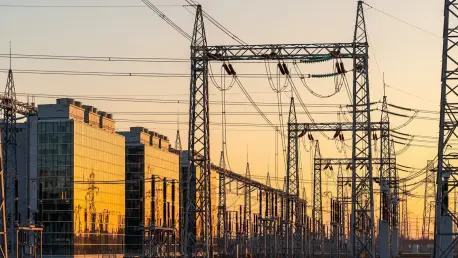
Interconnecting an 18-gigawatt pipeline—with another 43 gigawatts of requests currently under study—is an engineering feat that requires massive high-voltage substations and sophisticated load-balancing technologies to prevent local grid collapse. We aren’t just plugging in a building; we are essentially integrating small cities’ worth of demand into the existing fabric of the Mid-Atlantic and Midwest. To manage the financial exposure, we utilize transmission security agreements, which ensure that the developers of these data centers bear the initial financial burden and provide guarantees before we break ground on dedicated infrastructure. This protects our general rate-paying public from being left with the bill if a tech giant decides to pivot or abandon a site. Witnessing this 16% growth firsthand is exhilarating, but the sensory reality of seeing miles of new steel and conductor wire is grounded by the cold, hard math of these ironclad financial contracts.
Residential power supply costs in certain regions have surged by 80% over the last five years. How would allowing utilities to own generation assets help stabilize these prices, and what specific legislative changes are necessary to make this a reality in markets that currently bar the practice?
The 80% surge in supply costs across the Mid-Atlantic is a wake-up call that the current market structure is failing the average household’s wallet. By allowing utilities to own generation assets, we can move away from the volatility of merchant markets and provide “utility-led solutions” where the costs are regulated and predictable rather than driven by the highest bidder in a daily auction. To make this happen, we need state-level legislative changes in places like Pennsylvania to overturn decades-old restructuring acts that forced the divestiture of power plants. While I acknowledge that passing such bills in an election year with a divided government is a “long shot,” the reality is that without this shift, we will be having the same painful conversation about affordability in three to five years. We are advocating for an “all-of-the-above” approach that blends merchant investment with the stability of a rate-regulated utility footprint.
Large-scale transmission projects can cost billions of dollars and often require partnerships to complete. When bidding on massive regional projects, what criteria do you use to select partners, and how do you coordinate the construction of multi-state infrastructure to ensure it meets strict reliability deadlines?
When we look at projects like the $1.9 billion Illinois transmission bids within MISO’s Tranche 2.1, we seek partners who bring complementary operational strengths and shared risk appetites, such as our recent collaboration with Invenergy. Our criteria focus on a partner’s ability to navigate the labyrinth of multi-state permitting and their track record of delivering steel in the ground on schedule. Coordinating infrastructure across state lines is a logistical ballet involving thousands of workers and hundreds of local stakeholders, where a single delay in one county can ripple across the entire project timeline. We rely on centralized project management offices that integrate real-time data to ensure that every mile of the 7.9% rate base growth we’ve projected is executed with precision. It’s about more than just capital; it’s about the sweat and coordination required to ensure the lights stay on for millions of people while we build through complex terrain.
With pending rate hikes in Maryland and Delaware seeking returns on equity of 10.5%, how do you balance investor expectations with the need for customer affordability? Please describe the metrics you use to evaluate whether a rate increase is sustainable for the average residential household.
Balancing a 10.5% return on equity (ROE) with the needs of a family in Maryland or Delaware requires a transparent look at the actual dollar impact on a monthly bill. In Maryland, we are looking at a $120 million hike which translates to a 5.9% increase for the average residential customer, while in Delaware, the $45 million request equates to about a 4.4% bump. We evaluate sustainability by looking at the “total bill impact” relative to regional inflation and median household income to ensure that our $919 million in first-quarter income isn’t coming at the expense of a customer’s ability to heat their home. These rate cases are essential because they provide the capital necessary to upgrade aging wires and poles, which ultimately prevents the even higher costs associated with major outages and emergency repairs. We believe that by keeping these increases to single-digit percentages, we are maintaining a fair deal for the investors who fund our growth and the families who rely on our service.
What is your forecast for the evolution of the power grid as it faces the dual pressure of aging infrastructure and the rapid expansion of energy-intensive industries like data centers?
My forecast is that we are entering an era of “hyper-transmission” where the traditional boundaries between local utilities and regional power hubs will essentially vanish. We are looking at a future where the 18-gigawatt “high probability” pipeline is just the tip of the iceberg, and the grid will need to be rebuilt as a high-tech, bi-directional network capable of shifting massive amounts of power across state lines in milliseconds. I expect that between $12 billion and $17 billion in potential transmission investment—not even currently in our plan—will become mandatory requirements within the next decade to prevent widespread instability. This evolution will be expensive and technically grueling, but it is the only way to accommodate the digital economy while finally replacing the aging assets that have served us since the mid-20th century. The grid of 2030 will look less like a series of isolated pipes and more like a massive, integrated motherboard that powers everything from AI clusters to the neighborhood electric vehicle charger.