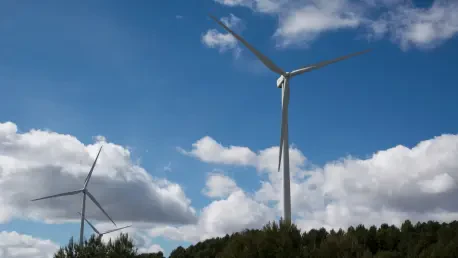

Short-term energy gaps are often bridged by lithium-ion batteries that handle the sunset ramp when solar generation fades before nocturnal wind patterns have fully developed. This delicate synchronization represents the central challenge of the modern energy era, where the traditional reliance on fuel-burning generators is being augmented by a massive influx of variable renewable resources. As the global industrial landscape transitions toward a decarbonized future, the complexity of maintaining a functional electric grid has increased exponentially. In the United States, this requires keeping the system frequency at a precise 60 hertz to ensure that every motor, computer, and household appliance operates without interruption. When wind turbines, which provide a significant and growing portion of the total energy mix, experience a sudden lull, the immediate deficit in generation threatens to destabilize this frequency. Grid operators are forced to manage a constant tug-of-war between supply and demand, where even a momentary mismatch can lead to systemic collapse. This article explores the multi-layered defense mechanisms that keep the lights on during these critical intervals, examining how technology, policy, and physical infrastructure work in tandem to mitigate the inherent volatility of nature. The stakes are particularly high in regions with high renewable penetration, where the margin for error is shrinking as traditional baseload plants are retired in favor of cleaner but less predictable alternatives.
Anatomy of a Grid Emergency
The September 2023 Texas Case Study
A clear example of this challenge occurred in Texas on the evening of September 6, 2023, during a period of extreme heat that tested the limits of the state’s independent power network. As the sun began to set, solar power production naturally dropped off, but an unexpected “wind lull” simultaneously caused wind generation to plummet far below forecasted levels. This created a “perfect storm” where electricity demand from air conditioners was hitting seasonal highs just as the state’s two largest renewable sources were fading. The Electric Reliability Council of Texas (ERCOT) found itself in a precarious position, watching the reserves of available electricity dwindle in real-time while the population remained oblivious to the looming threat of rolling blackouts. This specific event highlighted how the convergence of environmental factors can expose the vulnerabilities of a grid that has become increasingly dependent on weather-driven energy. The incident served as a wake-up call for planners who had previously assumed that wind and solar would complement each other more consistently during peak demand periods.
The situation became so critical that ERCOT declared an Energy Emergency Alert Level 2, a rare move that signaled the grid was only one step away from mandatory power cuts. During this emergency, the grid frequency dipped to 59.77 hertz, a level that signals a high risk of systemic failure if not corrected within minutes. To put this in perspective, high-voltage engineering requires almost perfect precision; a drop of just a few tenths of a hertz can cause generators to automatically trip offline to protect themselves from mechanical damage, potentially triggering a cascading failure across the entire interconnection. This event served as a high-stakes test of the backup systems designed to prevent the grid from collapsing when nature fails to cooperate. Operators were forced to deploy every available resource, including expensive peaker plants and demand-side reductions, to arrest the frequency decline. The successful management of this crisis provided invaluable data on how the physical inertia of the system is changing as electronic inverters from renewables replace the heavy spinning masses of traditional steam turbines.
Strategic Reserve Enhancements: A Policy Response
Following the 2023 emergency, grid operators recognized that the existing safety margins were too thin to account for the increasing volatility of wind power and the growing unpredictability of weather patterns. To address this, ERCOT increased its minimum reserve threshold from 1,750 megawatts to 2,000 megawatts later that year, creating a more robust buffer against sudden drops in renewable output. This policy shift was not merely a bureaucratic adjustment but a fundamental change in how risk is priced and managed within the energy market. By mandating higher reserves, the state essentially buys insurance against the “dark doldrums” or wind lulls that can appear with little warning. This extra cushion provides operators with more breathing room to react when renewable output suddenly diverges from weather forecasts, allowing them to bring slower-moving thermal assets online without the immediate threat of a frequency collapse. The increased cost of maintaining these reserves is seen as a necessary trade-off for the stability required to support a modern digital economy.
During such events, the grid operator acts like a conductor, coordinating a complex series of interventions to stabilize the system through a hierarchical response plan. They activate every available power plant, even those that are usually offline or in standby mode, and work with market participants to find any remaining scraps of electricity available for purchase. These aggressive maneuvers allow the grid to stay pressurized and functional until the demand drops or the wind picks back up, ensuring that the critical balance of the interconnection remains intact. Furthermore, these policy enhancements have spurred investment in more flexible generation types that can respond to operator signals within seconds rather than hours. The evolution of these reserve requirements reflects a broader industry trend toward “firming” renewables, where the cost of backup generation is increasingly integrated into the long-term planning of the grid. As we look at the trajectory from 2026 to 2028, these reserve strategies will likely become even more sophisticated, utilizing artificial intelligence to predict exactly when and where these energy gaps will occur.
The Power of Diverse Energy Sources
The Stability of Thermal Generation: The Reliable Backbone
When wind and solar disappear, the primary replacement is dispatchable thermal generation, which acts as the grid’s backbone during periods of high volatility. Natural gas plants are particularly valuable in this context because they can be “ramped up” quickly, increasing their output in response to real-time commands from the operator to fill the void left by a wind lull. In many regions, natural gas remains the most reliable tool for maintaining frequency, often providing over 70% of the total load during extreme weather events when other sources are unavailable. The ability of a gas turbine to reach full power in a matter of minutes makes it the ideal partner for intermittent renewables, serving as a flexible insurance policy that can be called upon at any time. This relationship between gas and wind has become the standard model for many power markets, ensuring that the transition to clean energy does not come at the expense of reliable service. The physical reality is that until long-duration storage becomes more widespread, thermal generation provides the essential “spinning reserve” that keeps the grid stable.
Complementing natural gas are coal and nuclear power, which serve as the “baseload” of the system by providing a steady and unchanging flow of electrons. While these plants are less flexible and cannot be turned on and off instantly, they provide a massive, unmoving foundation of energy that does not change regardless of the wind speed or the time of day. This “old guard” of generation ensures that there is always a minimum level of power flowing through the wires, supporting the underlying frequency of the grid even when the renewable fleet is entirely idle. For instance, nuclear facilities like Comanche Peak operate with a capacity factor that renewables cannot match, providing a reliable stream of carbon-free energy that anchors the entire system. Despite the push for newer technologies, these large-scale thermal plants remain indispensable for their ability to provide inertia—a physical property of rotating machinery that resists sudden changes in frequency. This inertia acts as a shock absorber for the grid, buying precious seconds for other backup systems to engage during an emergency.
Battery Storage as a Tactical Bridge
The rise of utility-scale battery storage has introduced a new, high-speed weapon for grid management that was virtually non-existent a decade ago. Facilities like the DeCordova Energy Storage Facility can discharge hundreds of megawatts of electricity almost instantaneously, making them far faster than even the most modern natural gas plants. This makes batteries perfect for handling the “sunset ramp,” a critical hour when solar power vanishes and wind hasn’t yet reached its evening peak. By discharging during these high-gradient periods, batteries prevent the frequency drops that used to characterize the evening transition in high-renewable markets. This technology has fundamentally changed the logic of grid operations, moving the system toward a more responsive and electronic-based control architecture. As battery costs continue to decline through 2026 and 2027, their role in providing “ancillary services”—such as frequency regulation and voltage support—will only expand, making them the first line of defense against any sudden loss of wind generation.
However, batteries are currently a short-term solution rather than a total replacement for traditional plants due to their limited discharge duration. While they can provide a massive burst of power to steady the grid’s frequency for an hour or two, most existing lithium-ion installations lack the energy density to sustain a grid through a multi-day wind lull. They are a tactical tool used to bridge the gap while slower-moving thermal plants are brought online or while operators wait for weather patterns to shift. For a grid to survive a prolonged period without wind, it still requires the energy density found in chemical fuels or nuclear reactions. This limitation is the focus of intense research and development, with newer chemistries like iron-air or flow batteries aiming to provide multi-day storage capabilities by 2028. For now, the primary value of the battery fleet lies in its ability to handle the “micro-shocks” of the grid, smoothing out the second-by-second fluctuations that turbines and solar panels introduce into the system, thereby allowing the larger thermal plants to run more efficiently and consistently.
Broader Coordination and Demand Tactics
Geographic Diversity: The Value of Interconnection
Wind lulls are rarely uniform across large distances, which is why regional coordination and expansive interconnection are so effective for maintaining stability. Regional operators like the Southwest Power Pool (SPP) manage markets that span multiple states, from the Canadian border down to the Texas Panhandle, allowing them to import wind power from one area to another. If the air is still in North Texas, it might be blowing a gale in Kansas or Oklahoma, and high-voltage transmission lines allow that energy to travel hundreds of miles to where it is needed most. This connectivity essentially treats the entire Midwest and Great Plains as a single, massive energy pool, leveraging the statistical probability that the wind is blowing somewhere within a million-square-mile area. By diversifying the geographic location of wind farms, operators significantly reduce the likelihood that the entire system will go quiet at once. This geographic “smoothing” is one of the most cost-effective ways to manage intermittency, as it utilizes existing wind assets more efficiently across a broader footprint.
Expanding these transmission networks is a core strategy for mitigating the “all-or-nothing” risk associated with localized weather patterns, yet it remains one of the most difficult infrastructure challenges due to regulatory and land-use hurdles. High-voltage direct current (HVDC) lines are being increasingly deployed to move large amounts of power with minimal loss, effectively linking disparate weather systems. For example, a storm front moving across the Rockies might trigger high wind production in the morning that can be sent eastward to meet the mid-day demand in Chicago. This level of coordination requires sophisticated market mechanisms that can price electricity in real-time across state lines, ensuring that power flows to the highest-value users. As the grid becomes more interconnected from 2026 toward the end of the decade, the reliance on any single local weather event decreases. The goal is to create a “continental grid” where the variability of individual wind farms is swallowed up by the vast scale of the total system, making the aggregate output far more predictable and stable than any single turbine could ever be.
Industrial Demand Response: Virtual Power Solutions
When increasing the supply of electricity is not enough to cover a wind lull, grid operators can balance the system by reducing the demand through sophisticated programs called “demand response.” Large industrial facilities, such as steel mills, chemical plants, and massive data centers, enter into contracts where they are paid to stand by and shut down their operations during emergencies. This creates a “virtual power plant” by freeing up hundreds of megawatts of electricity for other users within seconds. For a grid operator, a megawatt of reduced demand is functionally identical to a megawatt of new generation, but it is often much cheaper and faster to implement. This mechanism is far more efficient than building a traditional power plant that might only be needed a few times a year during the most extreme peaks. By asking a few large industrial players to pause their processes for an hour, the operator can prevent the need for residential rolling blackouts, protecting the most vulnerable consumers while maintaining the integrity of the high-voltage system.
This surgical approach to grid management has become increasingly automated, with data centers and “smart” industrial equipment capable of responding to frequency signals without human intervention. In a modern “smart grid,” the demand side is no longer a passive consumer but an active participant in maintaining stability. If the grid frequency drops, thousands of water heaters, industrial pumps, and electric vehicle chargers can be programmed to momentarily pause their consumption, providing a massive collective buffer that helps arrest the decline. This decentralized response is particularly effective at counteracting the sudden loss of a wind farm or a transmission line. As we move deeper into 2026, the integration of these demand-side resources is becoming a standard part of grid planning, with new market rules being written to allow smaller commercial and residential users to participate in these lucrative programs. It represents a shift from a “supply-follows-demand” model to one where both sides of the equation are flexible, creating a more resilient and efficient energy ecosystem that can handle the inherent “lumpiness” of renewable power.
Environmental and Infrastructure Realities
Physical Dependencies: The Role of Water and Fuel
Reliable electricity generation is deeply tethered to other physical infrastructures that are often overlooked, particularly the massive requirements for water in cooling systems. Thermal plants, including nuclear and natural gas facilities, require vast amounts of water to condense steam and operate safely, meaning that a state’s ability to survive a wind lull is often tied to its reservoir levels. Without sufficient water storage in lakes or rivers, even the best backup gas plants cannot function at full capacity during a heatwave. This water-energy nexus is a critical consideration for grid planners, especially in arid regions like the American Southwest where drought can threaten the availability of cooling water. The creation of artificial reservoirs, such as Lake Granbury in Texas, was a strategic decision made decades ago that continues to provide the essential cooling capacity for modern power plants today. This highlights the fact that the grid is not just a network of wires, but a complex synergy of natural resources and industrial engineering that must be managed as a whole.
To further ensure reliability, many modern plants utilize “dual-fuel” systems that allow them to switch between natural gas and liquid fuels like diesel during supply chain disruptions. For instance, a natural gas plant might keep a seven-day supply of diesel fuel on hand in case the gas pipelines are constrained by freezing weather or mechanical failure. This “belt and suspenders” approach to fuel logistics is essential for handling a “dunkelflaute”—a German term for a prolonged period of dark, still weather where renewables are offline for days at a time. During such events, the interdependence of the gas and electric sectors becomes a primary concern, as a failure in one can lead to a collapse in the other. By maintaining on-site fuel storage, power plants can operate as “islands” of reliability even if the broader fuel infrastructure is compromised. This physical redundancy is the ultimate safeguard against the unpredictable nature of both weather and global fuel markets, ensuring that the backup systems for wind power are themselves backed up by tangible, stored energy.
Navigating Future Growth: Projections From 2026 to 2028
As the electrification of the economy continues to accelerate, the total demand for power is hitting new record highs every year, driven by the proliferation of electric vehicles and the expansion of energy-intensive industries like artificial intelligence. Grid operators are finding that the energy transition is not a simple swap of one fuel for another, but rather an additive process where every new megawatt of wind and solar must be supported by an expanding backup system. The challenge from 2026 to 2028 will be to integrate this massive growth in demand without compromising the stability that modern society requires. This means that for every gigawatt of wind capacity added to the grid, planners must also account for the storage or dispatchable generation needed to cover that capacity when the wind stops. The goal is to reach a state of “stability amidst volatility,” where clean energy is maximized while the reliability of the system remains absolute. This requires a level of long-term planning and investment that spans decades, far beyond the immediate concerns of the current season.
The evolution of the grid over the next few years will likely see a move toward more “hybrid” power plants that combine wind, solar, and batteries at a single site. These facilities can act more like traditional power plants, providing a steady and predictable output by using the batteries to “smooth” the fluctuations of the renewable components. This technological integration simplifies the job of the grid operator, as the volatility is managed at the source rather than across the entire interconnection. Furthermore, the adoption of advanced weather forecasting and grid-edge computing will allow for more precise management of energy flows, reducing the amount of “spinning reserve” that must be kept in standby mode. While the transition presents significant technical hurdles, it also offers an opportunity to build a more resilient and efficient energy system than the one it replaces. The move toward a multi-resource grid is not just an environmental imperative but a logistical necessity as we build the infrastructure required to power the next generation of industrial and technological advancement.
The Strategic Path Forward for Grid Resilience
The integration of advanced monitoring and multi-layered backup systems proved that maintaining stability during wind lulls was a manageable engineering task rather than an insurmountable barrier. Observations of recent grid emergencies demonstrated that a combination of physical inertia, high-speed battery response, and industrial demand reduction was sufficient to prevent systemic failure even under extreme conditions. The transition away from a pure baseload model toward a more dynamic, multi-resource system required significant adjustments in how market participants valued reliability and frequency control. As the industry progressed through 2026, the reliance on natural gas as a flexible “peaker” resource remained a cornerstone of the strategy, providing the necessary firm capacity that batteries could not yet sustain for long periods. These developments shifted the focus of grid operators from simple supply management to a more nuanced coordination of diverse assets that functioned as a cohesive whole.
The successful navigation of these energy gaps established a clear roadmap for future infrastructure investments, emphasizing the need for increased transmission capacity and diversified storage technologies. Planners recognized that geographic diversity acted as a natural insurance policy, spreading the risk of intermittent lulls across entire regions. Furthermore, the expansion of demand-response programs transformed large energy consumers into active partners in grid stability, creating a more flexible and responsive ecosystem. By focusing on the synergy between clean energy and reliable backup, the modern grid achieved a level of resilience that allowed for the continued growth of renewable capacity. The lessons learned from previous emergencies provided the data necessary to refine reserve thresholds and automate emergency responses, ensuring that the power system remained robust in the face of an increasingly unpredictable climate. This comprehensive approach to grid management secured the foundation for a sustainable and reliable energy future.