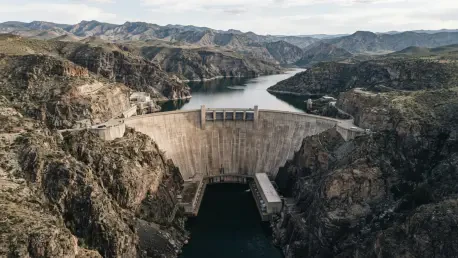

The physical scale of the Baihetan Dam is defined by a sophisticated double-curvature concrete arch that rises 289 meters to manage immense hydrostatic pressure. As a central component of the West-to-East Power Transmission initiative, this structure spans the Jinsha River, which forms the upper reaches of the Yangtze, effectively bridging the rugged mountainous divide between Sichuan and Yunnan provinces. This facility is not merely a generator of electricity but a symbol of a broader economic strategy designed to balance regional disparities. By harnessing one of the world’s most powerful river systems, the station provides a steady flow of renewable energy to the industrial heartlands of the coast. The sheer magnitude of the project ranks it as the second-largest hydropower facility globally, illustrating a masterclass in civil engineering that transforms geographical barriers into strategic assets. Its presence marks a definitive shift in how energy is harvested and transported across vast distances to sustain modern industrial growth.
Architectural Prowess and Technological Sovereignty
Part 1: Engineering Innovation and Structural Integrity
The implementation of 1,000-megawatt turbines at the facility represents a historic milestone in mechanical engineering, as no other project globally had successfully operated single units with such massive capacity prior to this development. These colossal generators were designed, manufactured, and assembled entirely within domestic borders, signaling a pivotal transition from a consumer of foreign technology to a global leader in heavy machinery and renewable energy infrastructure. The technical mastery required to produce these units involved solving complex problems related to heat dissipation, structural integrity, and electromagnetic stability at scales never before seen in the industry. By achieving complete technological sovereignty over the production process, the project demonstrated that high-capacity hydropower components can be developed in-house, reducing reliance on external supply chains and setting a new global standard for turbine manufacturing excellence.
Beyond the visible concrete arch, much of the engineering brilliance remains hidden within the surrounding mountains, where massive underground caverns house the primary power-generation systems. These subterranean halls, excavated into the rock of the Jinsha River valley, are among the largest of their kind in the world, specifically designed to protect the equipment while minimizing the surface footprint of the facility. The excavation process required high-precision blasting and advanced geological monitoring to ensure the stability of the mountain walls throughout the construction phase. Within these caverns, two separate powerhouses located on each bank operate in tandem, containing the sixteen massive generating units that form the heart of the station. This subterranean layout not only preserves the integrity of the local environment but also provides a controlled atmosphere for sensitive electronic and mechanical systems, ensuring long-term operational durability.
Part 2: Automated Operations and Digital Management
Operational efficiency at the plant is defined by a highly advanced digital management system that allows the facility to function with a remarkably lean workforce of approximately 400 employees. This small team oversees a total capacity of 16,000 megawatts, a feat made possible through the deep integration of artificial intelligence and high-level automation protocols. These digitized control systems continuously monitor thousands of data points in real-time, adjusting turbine speeds and water flow to maintain optimal efficiency without the need for constant human intervention. The precision offered by this automated approach ensures that the facility can reliably meet the daily household electricity requirements of roughly 75 million people, even during periods of high grid demand. By leveraging such sophisticated software and hardware integration, the station serves as a blueprint for the future of smart energy management, where human expertise is augmented by autonomous systems.
The ability to manage such a massive energy output with high precision is critical for maintaining the stability of the national grid, especially when integrating other variable renewable sources like wind and solar. Advanced sensors distributed throughout the dam and powerhouses provide instantaneous feedback on the structural health of the facility and the mechanical performance of the generators. This data is processed through a centralized digital twin, a virtual replica of the station that allows engineers to predict maintenance needs and simulate different operational scenarios. This predictive capability reduces downtime and extends the lifespan of the equipment, ensuring that the massive capital investment remains productive for decades. The seamless interaction between physical infrastructure and digital oversight highlights a new era of engineering where the boundaries between mechanical hardware and software are increasingly blurred, allowing for a level of control once thought impossible.
Strategic Energy Distribution and Environmental Impact
Part 1: Regional Connectivity and Grid Integration
This hydropower station acts as a vital component of a four-dam cascade along the Jinsha River, working in coordination with the Wudongde, Xiluodu, and Xiangjiaba facilities to maximize the energy harvested from the river’s descent. This sequential development strategy ensures that the water flow is utilized multiple times as it moves downstream, creating a highly efficient energy corridor that captures nearly every available kilowatt-hour of potential energy. The coordination between these stations is essential for regulating water levels and managing seasonal flow variations, which helps to prevent flooding while maintaining a consistent energy supply. By treating the river as a single integrated system rather than a series of disconnected projects, the regional power authority has created a robust energy backbone that supports the economic vitality of the entire Yangtze River basin. This cascade approach demonstrates how large-scale planning can optimize natural resources.
The energy generated at the border of Yunnan and Sichuan is primarily destined for the industrial hubs of Jiangsu and Zhejiang, located more than 2,000 kilometers to the east. To bridge this immense distance without significant energy loss, the project utilizes ultra-high-voltage direct-current transmission lines operating at ±800 kilovolts. This UHV technology is a critical enabler of the national energy strategy, allowing for the efficient transport of electricity across the continent with minimal resistive losses. By linking the resource-rich but mountainous western provinces with the energy-hungry manufacturing centers of the eastern coast, the transmission network effectively balances the national energy equation. This infrastructure not only supports the industrial output of the coast but also facilitates the economic development of the western regions by providing a stable market for their natural resources, creating a mutually beneficial link between disparate parts of the country.
Part 2: Environmental Stewardship and Carbon Mitigation
From a climate perspective, the facility serves as a cornerstone of the national carbon reduction strategy by providing a massive source of clean, renewable energy that directly replaces fossil fuel combustion. By generating approximately 62.44 billion kilowatt-hours annually, the plant offsets the consumption of nearly 19.6 million tons of standard coal, which would otherwise contribute to atmospheric pollution. This transition results in a significant reduction of carbon dioxide emissions, estimated at 51.6 million tons per year, playing a major role in achieving long-term sustainability goals. The displacement of coal-fired power not only mitigates the greenhouse gas effect but also reduces the emission of sulfur dioxide and nitrogen oxides, improving air quality in the regions that receive this clean power. As a result, the dam is a critical tool for decoupling industrial growth from carbon intensity, demonstrating that massive energy needs can be met through low-carbon alternatives.
While the engineering benefits are substantial, the project administrators have also implemented comprehensive programs to manage the ecological impacts associated with large-scale damming. To address concerns regarding the alteration of river ecosystems, specialized fish conservation programs were established, including the creation of breeding stations and managed release programs for endemic species. These initiatives aim to maintain the biodiversity of the Jinsha River by ensuring that migratory patterns and reproductive cycles are supported despite the presence of the dam. Additionally, the structure provides a critical flood-control mechanism for the Yangtze River basin, protecting downstream communities from the devastating effects of seasonal floods. By regulating sediment flow and improving river navigability, the project offers a range of logistical benefits that extend far beyond power generation, proving that infrastructure of this scale must be managed as a multifunctional ecological tool.
Socioeconomic Evolution and Historical Development
Part 1: Regional Transformation and Economic Integration
The construction of the project fundamentally altered the social and economic fabric of the surrounding areas, leading to a modernization process that has integrated formerly isolated regions into the national economy. This transformation required the relocation of numerous riverside villages into planned housing settlements, which offered upgraded amenities and improved living standards compared to the previous rural infrastructure. In areas like Qiaojia County, what was once a remote locale has become a vibrant hub characterized by multistory residential buildings and wide, paved roads. These new settlements were designed with a focus on long-term habitability, featuring schools, healthcare centers, and landscaped waterfronts that have stimulated a burgeoning local tourism sector. This shift has provided residents with diverse employment opportunities outside of traditional subsistence farming, fostering a new era of economic growth that is directly tied to the national energy infrastructure.
Integrating these mountainous regions into the broader economic landscape involved more than just building houses; it required a complete overhaul of the regional transportation and communication networks. New highways and bridges constructed as part of the project have significantly reduced travel times between the dam site and regional urban centers, facilitating the flow of goods and services. This improved connectivity allowed local businesses to reach wider markets, while the influx of workers and tourists created a demand for services and hospitality that did not previously exist. While the resettlement process represented a profound change for thousands of families, the focus on sustainable development aimed to ensure that the economic benefits of the dam were shared by those living in its immediate vicinity. The result is a region that is more resilient and better equipped to participate in the national economy, demonstrating how infrastructure can act as a catalyst for social change.
Part 2: Future Horizons and Infrastructure Resiliency
The realization of this hydropower project was a multigenerational endeavor that began with initial site identification in 1959 and culminated in full grid connectivity by late 2022. Following years of geological assessments and rigorous feasibility studies, the construction phase moved with notable speed, proving the viability of large-scale domestic manufacturing. Once the final generating units were synchronized, the facility provided an immediate boost to the stability of the regional power supply and confirmed the reliability of the 1,000-megawatt turbine design. This milestone demonstrated that the integration of massive renewable energy sources into a complex national grid was both technically feasible and economically sound. By successfully navigating the technical challenges of double-curvature arch construction and UHV transmission, the project set a precedent for future infrastructure ventures that require a balance between industrial power needs and carbon reduction targets.
To build upon this foundation, engineers and policymakers focused on long-term data collection to refine the performance of the digitized management systems for future installations. This research offered actionable insights into the maintenance of subterranean powerhouses and the optimization of turbine efficiency under varying hydrological conditions. Furthermore, the successful integration of western energy resources into the eastern industrial grid established a roadmap for expanding the UHV network to other renewable energy projects, such as large-scale wind and solar farms. These subsequent steps ensured that the technological advancements pioneered at the station became standardized across the industry, driving down costs and improving the resilience of the national energy infrastructure. The legacy of the project was thus defined not only by its physical stature but by the knowledge it provided for the transition toward a more sustainable and technologically advanced energy landscape.