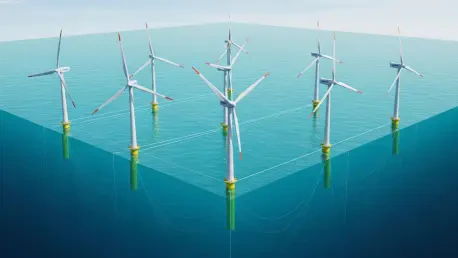

The global transition toward renewable energy has reached a critical juncture where traditional fixed-bottom offshore wind turbines are no longer sufficient to meet the surging electricity demands of coastal megacities. As shallow-water sites become increasingly crowded and environmentally sensitive, the industry is pivoting toward deeper ocean territories where the wind is more consistent and powerful. However, the current reliance on massive, heavy platforms made of thousands of tons of steel and concrete presents a significant logistical barrier that threatens to slow down the energy transition. Many existing floating designs prioritize sheer bulk to counteract the violent forces of the open sea, which leads to exorbitant manufacturing costs and complex installation requirements. By rethinking the fundamental physics of maritime stability, engineering firms are exploring ways to replace static weight with dynamic balancing systems that allow structures to remain upright without being anchored by immense mass. This shift represents a move toward a more agile and scalable model for oceanic power generation that could redefine the economics of offshore wind.
Engineering a Dynamic Solution for Deep Water
Replacing Mass: The Role of Mechanical Synergy
Gazelle Wind Power has introduced a revolutionary design that utilizes a central counterweight suspended between three anchored arms to maintain stability in turbulent offshore environments. This configuration functions similarly to the long pole held by a tightrope walker, providing a low center of gravity and a restoring force that reacts instantly to external pressures. Instead of fighting against the relentless motion of the waves through brute force, the platform incorporates a mechanical system that allows it to move in harmony with the sea. This synergy significantly reduces the mechanical stress placed on the turbine tower and the floating hull, as the counterweight absorbs much of the kinetic energy that would otherwise cause excessive tilting. By keeping the turbine’s pitch within a narrow five-degree range, the system ensures that the blades remain optimally positioned to capture wind energy, even during severe weather events that would force heavier structures to shut down for safety.
The mechanical synergy of this design is further enhanced by the way the counterweight interacts with the mooring lines and the buoyant arms of the platform. When a wave strikes the structure, the counterweight shifts to counteract the tilting force, creating a dynamic equilibrium that is far more efficient than the static ballast used in traditional semisubmersibles. This movement is precisely calculated to minimize the heave and surge motions that typically degrade the performance of floating wind turbines over time. Because the platform does not rely on massive amounts of submerged material to stay upright, it experiences less drag and hydrodynamic resistance, which improves its overall durability in high-sea states. This approach allows for the deployment of turbines in locations with extreme wave heights that were previously considered too hazardous for floating infrastructure. By leaning into the ocean’s natural movements, the technology provides a more resilient foundation for clean energy.
Enhancing Stability: Structural Flexibility in Design
Unlike conventional semisubmersible platforms that require deep drafts and massive submerged hulls to prevent capsizing, this geometry-based approach relies on the tension of the mooring system. The interplay between the floating buoy and the submerged counterweight creates a stable equilibrium that does not require the thousands of tons of ballast typically found in traditional designs. This reduction in dead weight translates directly to a decrease in the amount of steel and concrete needed for construction, making the entire assembly lighter and more buoyant. Furthermore, the flexibility inherent in the design allows it to dissipate wave energy more effectively than a solid, unyielding mass. Engineers have found that by allowing the platform to tilt and recover naturally, they can achieve a high level of stability with a much smaller physical footprint. This methodology challenges the long-standing industry assumption that bigger is always better, proving that design can outperform simple mass.
The reduction in material intensity is not merely an engineering achievement but a fundamental shift in how marine structures are fabricated and deployed. By utilizing a lighter hull, the platform requires significantly less raw material, which reduces the environmental impact of the manufacturing process itself. This leaner design also enables a higher degree of modularity, as the individual components can be produced in standard industrial facilities rather than specialized shipyards with heavy-load capacities. As the industry moves toward larger 15-megawatt turbines, the ability to maintain structural integrity without adding exponential amounts of weight becomes a critical competitive advantage. The geometric configuration of the floating arms and the central pivot point ensures that the stresses are distributed evenly across the frame, preventing localized fatigue and extending the operational lifespan. This focus on structural efficiency allows developers to maximize power output while minimizing the resources required.
Maximizing Logistical and Financial Efficiency
Streamlining Operations: Mooring Systems and Port Access
The logistical advantages of this design are currently being demonstrated through the Nau Azul project, a 2-megawatt pilot situated off the northern coast of Portugal. This initiative serves as a critical real-world test, having secured nearly $20 million in funding to evaluate how the counterweight system performs in the harsh environment of the Atlantic Ocean. Because the platform has a naturally low draft, it was assembled in a standard shallow-water port and towed out to the test site using conventional maritime vessels. This eliminates the need for expensive deep-water infrastructure and specialized heavy-lift cranes, which are often unavailable in many regions looking to expand their renewable energy capacity. By utilizing existing shipyard capabilities, the project highlights how modular designs can be integrated into the current maritime economy without requiring massive capital investment in new port facilities. This approach provides a practical model for deployment in emerging offshore wind markets.
Furthermore, the Nau Azul project is providing essential data on the platform’s mooring requirements, which are significantly reduced compared to traditional floating designs. The innovative geometry allows for an 80% reduction in the total length of mooring lines and a similar decrease in the overall seabed footprint. This not only lowers the upfront material costs but also reduces the environmental disturbance to sensitive marine ecosystems. Independent evaluations of the project site have confirmed that the smaller footprint simplifies the permitting process and minimizes conflicts with other maritime activities such as fishing and shipping. As the industry looks toward commercial-scale developments, the ability to deploy large arrays of turbines with minimal seafloor impact will be a key factor in securing public and regulatory approval. The success of this demonstration in Portuguese waters serves as a vital proof of concept for the efficiency of the counterweight design.
Optimizing Economics: Scaling and Commercialization
The economic implications of reducing material consumption are profound, as steel prices and supply chain volatility remain constant challenges for large-scale renewable energy infrastructure. By cutting the amount of steel required for each platform, developers can significantly lower the levelized cost of energy, making floating offshore wind competitive with established fossil fuel alternatives. The modular nature of the platform also facilitates rapid mass production, as components can be manufactured in parallel at different facilities and then transported to a hub for final assembly. This approach is specifically designed to scale alongside the industry’s push toward massive 15-megawatt turbines, which are becoming the new standard for utility-scale projects. The current project timelines for the industrial rollout, spanning from 2026 to 2030, emphasize the rapid deployment of these units to meet growing clean energy demands. The shift toward a more efficient use of materials ensures that capital is allocated more effectively.
The successful implementation of geometry-based stability systems marked a turning point in the commercialization of deep-water wind energy. By moving away from the paradigm of massive weight, developers effectively addressed the high costs and logistical constraints that had previously limited the growth of the sector. These innovations allowed for the rapid expansion of wind farms into diverse maritime environments, providing a scalable solution for global energy needs. Strategic partnerships with international manufacturers ensured that the platforms were produced with high efficiency, while pilot projects demonstrated the robustness of the technology in harsh conditions. Stakeholders throughout the industry recognized that the transition to a more balanced and agile structural design was essential for achieving long-term sustainability goals. Moving forward, the focus shifted toward integrating these advanced platforms into a globalized supply chain. The lessons learned from this transition provided a clear roadmap for future oceanic infrastructure.