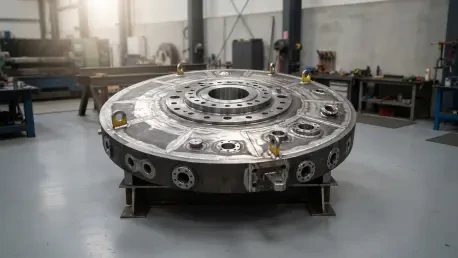

In the curved arc segment of a turbine top cover, tangential sediment velocity acts as the primary driver for accelerated material degradation. Hydroelectric power facilities located in geologically active regions, such as the eastern margin of the Qinghai-Tibet Plateau, face a relentless mechanical adversary in the form of sediment erosion. The Minjiang River Basin, which feeds the Gengda Hydropower Station, is characterized by steep topography and intense seasonal runoff that carries a high concentration of hard, sharp-edged quartz sand. While researchers and maintenance crews have traditionally focused on the erosion of rotating components like runner blades and guide vanes, the stationary top cover of a Francis turbine remains equally vulnerable. This critical component sits above a confined hub cavity where turbulent secondary flows and intense vortex structures create a localized environment of severe scouring. Unchecked, this erosion not only degrades the hydrodynamic efficiency of the plant but also poses a severe structural risk, as perforation of the top cover can lead to the catastrophic flooding of the powerhouse.
Modeling the Hydrodynamic Environment
Analyzing Fluid and Sediment Interaction
To understand the complex physical forces at play within the turbine, researchers established a hydrodynamic baseline using advanced Computational Fluid Dynamics. The full-passage Francis turbine was modeled across three distinct guide vane openings of 5.96, 11.95, and 15.33 degrees, representing various operational loads expected during the current 2026–2028 production cycle. The 15.33-degree opening, which corresponds to a standard 40-megawatt load, was identified as the most critical regime for material integrity. Under these specific conditions, the static pressure and sediment concentration within the runner hub cavity reached their peak, creating the highest potential for rapid material removal. This simulation utilized an Eulerian-Eulerian two-fluid framework, which treats the water and the entrained sediment as interpenetrating continua. This specific modeling approach is particularly effective for high-concentration flows where interphase momentum exchange is a dominant factor in determining the wear patterns across the stationary surfaces of the machine.
The accuracy of these numerical models was ensured by employing the standard k-epsilon turbulence model paired with scalable wall functions, which allow for precise calculations near the boundary layers. This approach was validated against field measurements from the prototype turbine at the Gengda facility, showing a maximum relative efficiency discrepancy of only 2.2 percent. The findings revealed that fluid entering through the crown seal clearance undergoes severe throttling across the labyrinth rings, yet near the inlet of the hub cavity, localized sediment velocities can reach staggering speeds of 40 meters per second. By mapping these high-velocity zones, engineers can now predict where the most aggressive erosion will occur before the turbine even enters its next service interval. This level of predictive modeling is essential for scheduling preventive maintenance and ensuring that the structural components of the turbine can withstand the seasonal surges of abrasive sediment common in mountainous river systems.
Identifying High Velocity Erosion Zones
The simulations further highlighted how the internal geometry of the hub cavity contributes to accelerated wear. As sediment-laden water passes through the restricted seal clearances, the flow undergoes a transition from high pressure to high velocity. This high-speed flow, combined with the centrifugal forces generated by the rotating runner, pushes abrasive quartz particles toward the stationary walls of the top cover. The resulting environment creates a “perfect storm” for material removal, where particles impact the steel surfaces at high frequencies and velocities. The research indicated that the concentration of particles is not uniform; rather, it clusters in areas of lower pressure, creating localized “hot spots” of erosion that can wear through standard cast steel significantly faster than the average erosion rate across the rest of the component surface would suggest.
Furthermore, the interaction between the tangential and radial velocity components determines the specific angle at which the sediment grains strike the metal. In the curved segments of the top cover, the tangential velocity is the dominant force, causing particles to graze the surface at shallow angles. In the radial flat segments, however, the flow vectors shift, leading to different impact dynamics that require a robust material response. Understanding these localized velocity vectors is crucial because the efficiency of a protective overlay depends heavily on its ability to resist both the micro-cutting action of grazing impacts and the deformation caused by more direct strikes. By identifying these zones through three-dimensional modeling, hydropower plant operators can apply targeted weld overlays to the most vulnerable areas, optimizing the use of expensive high-performance alloys while maximizing the protection of the underlying turbine structure.
Material Properties and Rebuild Procedures
Comparing Base Metal and Stainless Overlays
The core of recent material research involves a direct comparison between the traditional ZG20SiMn cast steel base metal and the specialized H05Cr12Ni4Mo stainless steel weld overlay. The ZG20SiMn steel is a standard low-alloy casting material characterized by a composition of approximately 0.20 percent carbon and 1.14 percent manganese. While this material is sufficient for providing the general structural integrity and load-bearing capacity required for the top cover, it lacks the inherent hardness and corrosion-erosion resistance necessary to withstand the relentless scouring of quartz sand. In contrast, the H05Cr12Ni4Mo alloy is a high-performance stainless steel repair material featuring a sophisticated blend of 12.76 percent chromium, 4.39 percent nickel, and 0.728 percent molybdenum. These elements work in tandem to create a metallurgical structure that is far more resilient to the mechanical stresses of abrasive wear.
The disparity in the chemical makeup of these two materials translates directly to their measurable mechanical performance during operational testing. Material characterization tests conducted in the 2026 research cycle showed that the H05Cr12Ni4Mo overlay possesses a mean Brinell hardness of 287, which is significantly higher than the 205 HB recorded for the ZG20SiMn base metal. Hardness is a primary indicator of a material’s ability to resist the penetration of abrasive grains; therefore, the higher hardness of the overlay allows it to deflect or minimize the impact of sharp sediment particles. This increased resistance is particularly vital in the context of hydro-abrasive wear, where the micro-cutting of the surface leads to the gradual thinning of the component. By replacing the surface layer with a material that is nearly 40 percent harder, the lifespan of the turbine top cover can be extended by several years, reducing the frequency of costly plant shutdowns and major overhauls.
Implementing the Weld-Rebuild Procedure
In modern hydropower maintenance, the application of the H05Cr12Ni4Mo overlay is performed through a specific weld-rebuild procedure designed to restore and enhance the component. The process begins by machining away the worn or damaged surface of the original ZG20SiMn top cover to a specified depth. A two-centimeter-deep layer of the high-performance stainless steel alloy is then applied using automated welding techniques to ensure a uniform and high-quality bond with the base metal. This depth is sufficient to provide a significant buffer against long-term scouring while maintaining the original design geometry of the turbine passages. The welding process must be carefully controlled to prevent the formation of heat-affected zones that could compromise the toughness of the underlying cast steel, ensuring that the repaired component remains structurally sound under the high pressures of operation.
This proactive approach to material engineering does more than just repair damage; it introduces a superior metallurgical barrier that changes the wear characteristics of the entire system. The inclusion of nickel and molybdenum in the weld overlay improves the overall toughness and fatigue resistance of the surface, which is critical for handling the vibrational stresses present in the turbine hub cavity. Once the welding is complete, the surface is ground and polished to match the original hydrodynamic profiles, ensuring that the repair does not negatively affect the efficiency of the water flow. This maintenance strategy has become a standard protocol for facilities like the Gengda Hydropower Station, where the objective is to move away from reactive “patch-and-repair” cycles toward a more sustainable and resilient infrastructure model that utilizes the latest advancements in metallurgy and welding science.
Experimental Outcomes and Industrial Implications
Measuring Erosion Rates in Laboratory Settings
To validate the findings from the numerical simulations, researchers utilized a scaled laboratory apparatus designed to replicate the punishing conditions of the Minjiang River environment. Because testing on a full-scale 40-megawatt turbine is impractical, the lab model used a reduced rotating disk radius driven at 2,000 RPM to match the peripheral wall velocity ratio of the prototype. The experiment was conducted over a continuous 170-hour period using natural sediment harvested from the river at a concentration of 2.9 kilograms per cubic meter. A critical aspect of the methodology involved the periodic replacement of the sand inventory to prevent “particle rounding,” a phenomenon where abrasive grains become dull over time in a closed-loop system. This ensured that the energy and abrasiveness of the particle impacts in the laboratory mirrored the real-world conditions encountered by the turbines during peak runoff seasons.
The resulting empirical data confirmed a massive performance gap between the repair material and the base metal. Measured erosion rates for the H05Cr12Ni4Mo overlay ranged from 0.1 to 0.7 micrometers per hour, with total wear depths generally staying within manageable limits. In stark contrast, the unclad ZG20SiMn base metal suffered significantly more damage, with erosion rates reaching 0.9 micrometers per hour and peak wear depths exceeding 0.15 millimeters in high-velocity zones. These measurements were captured using a high-precision Keyence laser displacement sensor, which provided a three-dimensional map of material loss with a reliability threshold of 0.27 micrometers per hour. The consistency of these results across multiple test cycles provided a validated technical foundation for hydropower plant operators, proving that the weld overlay is not merely an incremental improvement but a fundamental shift in wear resistance capability.
Linking Flow Vectors to Structural Longevity
The final stage of the analysis involved correlating the localized flow vectors with the observed surface morphology of the tested materials. The researchers found that in the curved arc segments of the top cover, tangential sediment velocity was the primary driver of erosion. Even a minor increase of one degree in the particle impact angle resulted in a significant jump in the erosion rate for the base metal. The physical appearance of the worn surfaces told a compelling story; the H05Cr12Ni4Mo alloy exhibited smooth abrasive tracks and shallow micro-cutting grooves, indicating that its high hardness successfully resisted deep penetration. Conversely, the ZG20SiMn steel showed signs of “plowing,” where the softer metal was pushed into ridges and furrows before eventually spalling off. This confirmed that the overlay effectively mitigates the mechanisms of destruction that typically lead to rapid structural thinning in Francis turbines.
The researchers successfully demonstrated that the strategic application of stainless steel overlays significantly extended the operational life of stationary turbine components. They concluded that the H05Cr12Ni4Mo repair material provided a robust defense against the micro-cutting and plowing actions of quartz sand, even under high-velocity conditions. Engineers established that moving away from traditional cast steel surfaces in favor of these specialized overlays allowed for longer intervals between overhauls and prevented catastrophic component failure. Plant operators utilized these insights to implement targeted maintenance programs, ensuring that renewable energy production remained stable throughout the harshest environmental conditions. The study effectively bridged the gap between complex fluid dynamic theory and practical metallurgical application, offering a definitive roadmap for creating more resilient hydroelectric infrastructure worldwide.