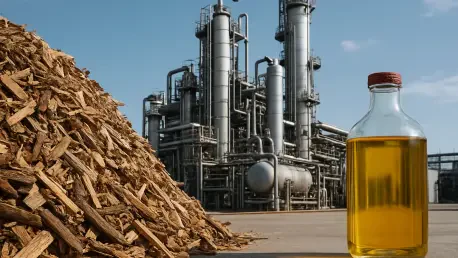

The dense forests of north-central Pennsylvania may soon hold the key to a more sustainable energy future as academic researchers and private innovators attempt to transform discarded timber residue into high-quality gasoline. This ambitious collaboration between the Penn State College of Agricultural Sciences and Woodland Biomass Innovations involves the proposed construction of a state-of-the-art facility in Tioga County designed to process massive quantities of regional wood waste. Every day, the plant aims to ingest approximately 1,000 tons of low-use woody biomass to generate 42,000 gallons of gasoline, along with significant quantities of renewable electricity and biochar. This initiative represents a sophisticated attempt to turn underutilized forest materials into high-value energy products that can integrate directly into the existing fuel infrastructure. By evaluating the operational model of the startup, university experts are ensuring that the process remains logistically sound and environmentally responsible from its inception.
Optimizing the Regional Supply Chain: A Localized Strategy
A fundamental element of the ongoing research involves the identification of a 25-mile viability radius surrounding the proposed Tioga County facility to ensure a sustainable feedstock supply. Researchers determined that this specific distance is the threshold where the energy required to transport heavy wood does not exceed the energy produced by the final biofuel product. By maintaining a hyper-local supply chain, the project minimizes the consumption of diesel fuel in hauling operations, which is often a major hidden cost in biomass energy ventures. This spatial optimization ensures that the facility remains economically competitive while significantly reducing the carbon footprint associated with logistics. Keeping operations within this radius also allows for better coordination with local harvesters, ensuring that the supply of woody biomass remains consistent and predictable throughout the year, even during the difficult winter months when forest access is restricted.
Furthermore, this localized approach directly addresses the urgent need for active forest management in the region by creating a market for materials that currently have little to no value. In many parts of Pennsylvania, the lack of demand for small-diameter trees and forest residues makes thinning operations prohibitively expensive for private landowners and state agencies alike. By providing a reliable outlet for these low-use materials, the facility incentivizes the removal of excess biomass that can otherwise fuel catastrophic wildfires or facilitate the spread of invasive pests and diseases. This removal process allows the remaining high-quality timber to grow more vigorously, enhancing the overall health and biodiversity of the forest ecosystem. The project thus transforms a liability—hazardous forest debris—into a valuable asset that supports both the local environment and the regional timber economy through sustainable harvesting practices.
Measuring Environmental Impacts: Life Cycle Assessments
To validate the environmental credentials of the proposed biorefinery, the research team conducted a rigorous Carbon Life Cycle Assessment to track every gram of emission generated. This comprehensive scientific evaluation monitors greenhouse gas emissions from the initial point of harvest through the processing stage and finally to the combustion of the gasoline in a standard internal combustion engine. Preliminary findings from the 2026 study suggest that gasoline derived from woody biomass possesses a significantly smaller carbon profile than traditional petroleum-based fuels extracted from fossil sources. This reduction is critical for meeting modern decarbonization targets, especially in sectors like heavy-duty transportation and rural logistics where electrification remains a challenge. The data provides a transparent look at how domestic energy production can mitigate climate impact without requiring immediate, massive overhauls of existing vehicle technology.
The refinery is designed to function as a circular industrial model, striving for maximum efficiency by generating its own operational power through the gasification process. A key byproduct of this conversion is biochar, a stable, carbon-rich material that offers unique opportunities for further environmental benefits beyond simple fuel production. If integrated into local agricultural practices, biochar can be used as a soil amendment to enhance moisture retention and nutrient availability, or it can be buried for long-term carbon sequestration. The inclusion of biochar in the life cycle model potentially shifts the entire facility toward a net-negative carbon status, meaning it could remove more carbon from the atmosphere than it releases during fuel production. This holistic view of the refining process highlights how modern technology can mimic natural cycles to produce energy while simultaneously restoring soil health and capturing atmospheric carbon.
Bridging the Gap: Research and Industrial Application
This collaborative effort serves as a primary example of the Technologies for Agriculture and Living Systems initiative, which aims to bridge the gap between academia and industry. By treating Pennsylvania as a living laboratory, the university allows students and postdoctoral researchers to apply complex theoretical models to a real-world industrial project with immediate social impact. Participants are gaining invaluable experience in spatial modeling, feedstock logistics, and chemical engineering, preparing a new generation of professionals to lead the emerging bio-economy. This hands-on approach ensures that the university remains at the forefront of technological advancement while providing startups with the technical expertise needed to refine their operational models. The integration of academic rigor into private enterprise helps refine the technology before significant capital is committed to large-scale construction.
Beyond the laboratory, the project leverages the expertise of the Penn State Extension biofuels team to integrate the new technology into the social and economic fabric of the state. These specialists work to connect the startup with established wood-product communities and local vocational programs to ensure a skilled workforce is available for the refinery’s future operations. This multidisciplinary support network includes engineers, educators, and community leaders who collaborate to ensure the project is socially acceptable and beneficial to the people of Tioga County. By engaging with local stakeholders early in the process, the initiative builds the trust necessary for long-term success and ensures that the facility becomes a permanent fixture of the regional economy. This outreach demonstrates that technological innovation is most effective when it is supported by a robust framework of education and community involvement.
Economic Growth: De-risking through Academic Validation
One of the most critical contributions of the university’s involvement is the ability to de-risk the venture for potential private investors and state funding agencies. Academic validation of the carbon intensity metrics and the feedstock availability provides a level of transparency and objective credibility that internal corporate reports often struggle to achieve. For a startup, having a world-class research institution verify its production calculations and environmental claims is essential for securing the large-scale financing required for industrial deployment. This verification process reduces the perceived uncertainty surrounding new technologies, making it easier for capital to flow into rural energy projects that might otherwise be overlooked. The rigorous scrutiny provided by the researchers ensures that the project is built on a foundation of verifiable data rather than optimistic projections.
The establishment of such a facility also promises to revitalize the rural economy of Tioga County by creating a variety of new job opportunities across several different sectors. From the logistics of harvesting and hauling forest residues to the technical roles required to operate and maintain the refinery, the project supports a wide range of livelihoods. By turning a previously worthless regional waste product into a high-value commodity, the initiative fosters sustainable industrial growth that does not rely on the depletion of non-renewable resources. This economic shift encourages the development of localized infrastructure and services, creating a ripple effect that benefits small businesses and school districts throughout the region. The project ultimately demonstrates that environmental stewardship and economic prosperity are not mutually exclusive, but can be achieved together through smart innovation.
Advancing Toward Sustainable Fuel Infrastructure: Future Steps
The research team concluded that the integration of woody biomass into the regional fuel supply offered a viable pathway for immediate carbon reduction in the transportation sector. They established that the logistical framework developed for Tioga County was robust enough to serve as a blueprint for similar installations in other timber-rich regions of the Appalachian Mountains. By focusing on existing internal combustion engine technology, the findings suggested that high-value biofuels could provide a transitionary solution that works within current economic constraints. The study identified that the next logical step involved the finalization of site-specific engineering plans to move the facility from a conceptual model into a physical reality. This transition was viewed as a critical milestone for demonstrating the scalability of localized biorefining technologies across the broader United States.
Stakeholders and researchers alike determined that the successful implementation of the 2026 phase required continued coordination between state regulators and private forest owners. The project showed that policy support for forest thinning and biomass removal was essential for maintaining the long-term health of Pennsylvania’s woodlands while securing the necessary feedstock. Furthermore, the analysis proved that the production of biochar as a secondary product was the most effective way to ensure the facility’s economic resilience against fluctuating fuel prices. The experts recommended that future iterations of the refinery should explore even deeper integration with local agricultural sectors to maximize the utility of every byproduct. These insights provided a clear direction for the next phase of development, ensuring that the momentum generated by the initial research was translated into tangible environmental and economic improvements.