
Local resistance groups in Manizales are challenging the corporate narrative by asserting that water is a material foundation for territory rather than a harvestable product. This burgeoning movement highlights a critical friction point in the national energy strategy, where the drive for renewable power often collides with the fundamental rights of rural communities. As Colombia navigates the current decade, the expansion of hydroelectric infrastructure has become a symbol of a broader extractivist model that prioritizes industrial utility over ecological health. The mountains of the Caldas department, historically defined by their abundant river systems, now serve as a battleground for defining the true meaning of progress. For many inhabitants, the introduction of massive dam projects represents more than just a change in infrastructure; it signifies a decoupling of the community from its natural heritage. This shift highlights a troubling paradox where the global push for clean energy creates localized environmental crises that are ignored by urban consumers.
The Structural Drive for Energy Expansion
National Policy: The Shift to Power Exportation
The current energy landscape in Colombia is defined by an overwhelming reliance on hydroelectric sources, which generate approximately 70% of the total electricity for the nation. This structural dominance was not an overnight development but the culmination of strategic policy shifts that began with the National Energy Plan extending into the mid-2020s. Under this framework, the state transitioned its view of electricity from a basic public service into a highly profitable export commodity. This market-oriented approach has been successful from a fiscal perspective, allowing the country to position itself as a regional energy hub. By the end of 2024, the valuation of electricity exports reached approximately $320 million, demonstrating the financial incentives driving the continuous expansion of river-based infrastructure. However, this success often comes at the expense of rural resource security, as the priorities of international markets supersede the immediate needs of the farming populations.
The legislative push to maximize energy production has created a regulatory environment that heavily favors large-scale corporate ventures over small-scale, decentralized energy solutions. As national planners look toward the 2026 to 2030 period, the focus remains on high-capacity projects that can feed the national grid and support neighboring economies through interconnections. This strategy relies on the assumption that water is an inexhaustible resource that can be diverted and dammed without significant long-term consequences for the surrounding basins. However, the aggressive nature of these interventions suggests a model of extractivism that mirrors the logic of the mining and fossil fuel sectors. Instead of creating a resilient and localized energy network, the current policy favors a centralized system that extracts value from rural territories and transfers it to industrial centers. This dynamic has left many communities feeling like collateral damage in a national quest for growth.
Regional Development: The Caldas Water Boom
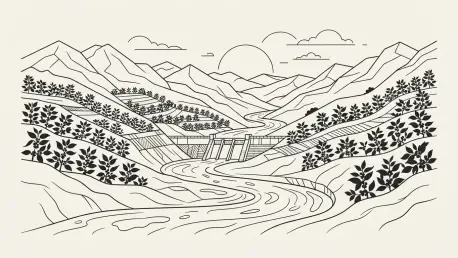
Caldas has emerged as a focal point for this industrial expansion due to its unique geography within the Central Cordillera and its proximity to major tributaries of the Magdalena River. The region’s transformation into an energy corridor intensified after the launch of the Hidromiel I dam in 2002, which set a precedent for large-scale river intervention in the area. Since that time, the landscape has seen a steady proliferation of hydroelectric facilities and river-diversion tunnels designed to maximize the volume of water moving through turbines. While four major projects are currently operational, the regional planning pipeline includes more than 40 additional projects in various stages of development. This rapid scaling of infrastructure has fundamentally altered the hydrology of the eastern part of the department, turning once-free-flowing rivers into managed reservoirs. For the local inhabitants, this influx of engineering has become a constant presence that redefines their daily relationship with the land and the water.
A notable contradiction within the development of Caldas is the fact that the department already maintains an electrification rate of nearly 100%, leaving little room for local benefit from new projects. This high level of existing coverage proves that the aggressive damming of regional rivers is not intended to provide power to the surrounding communities but to satisfy external industrial demand. This realization has fueled a sense of injustice among local residents who see their natural wealth being exported while they deal with the resulting environmental degradation. The corporate narrative often promises local job creation and infrastructure improvements, yet these benefits are frequently short-lived or limited to the construction phase. Once a dam becomes operational, the local economy often sees little long-term gain, while the ecological costs continue to mount for decades. This extractivist pattern demonstrates how the “green” label can be used to justify the exploitation of rural resources for the benefit of distant markets.
Material and Cultural Displacement
Technical Consequences: Disrupting the River Cycle
The technical reality of modern hydroelectric generation involves a destructive process where water is redirected through massive underground tunnels, often bypassing miles of natural riverbeds. This method causes a significant drop in the local water table as surface water naturally seeps into the voids created by the excavations. In the vicinity of the El Edén plant, the University of Caldas has documented the disappearance of several vital streams that were once the primary water sources for dozens of farming families. At least 80 households have reported a total loss of access to the water required for their domestic needs and agricultural irrigation, leading to a state of permanent water stress. When these small streams run dry, the local ecosystem experiences a cascade of failures, as the moisture necessary for healthy soil and diverse vegetation vanishes. This physical alteration of the landscape serves as a stark reminder that clean energy is not synonymous with impact-free development.
Beyond the immediate loss of water, the mechanical disruption of the river cycle causes long-term instability for traditional agricultural practices. Farmers who once relied on predictable stream flows for coffee and cocoa crops now find themselves in a desperate competition for dwindling alternative sources. This scarcity creates a ripple effect of socio-economic instability, as the lack of water directly translates into reduced yields and lower incomes for rural workers. The loss of these resources is perceived as a form of displacement that forces people to abandon their land in search of more viable living conditions. Unlike the visible destruction caused by mining, the damage from hydropower is often subterranean and gradual, making it harder for communities to quantify or legally challenge. This slow violence against the environment erodes the material foundation of rural life, making traditional farming increasingly impossible in areas targeted by energy corporations seeking to maximize power output for the grid.
Societal Impact: The Search for Resource Sovereignty
The erosion of identity among the farming populations of Caldas is a profound consequence of the ongoing water extractivism crisis. For these communities, water represents the core of hydrosocial networks, which are the complex cultural and social bonds formed through the shared management of natural resources. When a river is dammed or a stream disappears, these networks are severed, leading to an existential crisis that touches every aspect of rural life. Individuals who have spent their lives cultivating the land often describe the loss of their water sources in terms that mirror the trauma of forced displacement. This deep connection to the territory means that the destruction of the landscape is seen as a direct attack on the farmer’s identity. As traditional crops like cocoa and coffee become harder to sustain without reliable irrigation, the cultural fabric of the region begins to fray, threatening the continuity of knowledge and practices that have existed for generations.
To address these systemic failures, the MACO collective and other regional groups mobilized to demand a fundamental shift in how water and energy were governed. They asserted that a truly sustainable transition required the recognition of rivers as living entities and the protection of the people who lived alongside them. These advocates proposed that future projects had to prioritize local ecological balance and community consent over the simple extraction of value for global markets. It was concluded that environmental justice could only be achieved if the hidden costs of hydropower were fully integrated into national planning and corporate accountability. Ultimately, the struggle in Caldas showed that the preservation of territorial identity was as important as the reduction of carbon emissions. The actions taken provided a vital roadmap for aligning renewable energy development with the non-negotiable rights of nature and human communities, ensuring that progress did not come at the cost of local life.