
The vast expanses of the Arabian Peninsula have long served as the ultimate testing ground for human ingenuity in the face of extreme heat and chronic water shortages. While solar energy has historically been valued for its ability to convert abundant sunlight into clean electricity, a radical new hypothesis is transforming how scientists view these sprawling installations of glass and silicon. Researchers from the University of Hohenheim are currently investigating whether the immense thermal footprint of gigawatt-scale solar farms can be harnessed to alter local weather patterns and induce precipitation. This transition from purely energy-focused infrastructure to active climate-shaping tools represents a significant leap in geoengineering strategy. By leveraging the natural physics of heat absorption, these projects aim to solve the dual crises of energy demand and water scarcity simultaneously. The desert, once seen only as a barren source of power, is now being treated as a dynamic laboratory for atmospheric manipulation that could redefine life in arid regions across the globe.
The Physics of Heat: Creating Artificial Convection
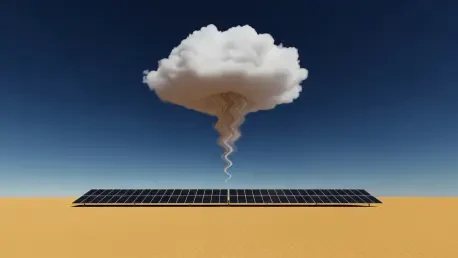
Dark solar panels absorb a massive amount of solar radiation, far exceeding the reflective capacity of the surrounding light-colored desert sands. This absorption creates a significant temperature differential, turning the solar farm into a massive thermal engine that heats the air immediately above the panels. As this air warms, it becomes less dense and begins to rise rapidly, creating a localized updraft known as a thermal plume. In coastal regions like the United Arab Emirates, where the atmosphere often contains moisture blowing in from the Persian Gulf, this upward movement can carry water vapor into the cooler layers of the upper atmosphere. This process mimics the natural formation of convective clouds that lead to summer thunderstorms but at a much more controlled and predictable scale. The goal is to create a reliable “chimney effect” that provides a consistent trigger for cloud formation, effectively mining the sky for water that would otherwise drift past without ever condensing into rain.
To achieve a meaningful impact on regional precipitation, the scale of the solar installation is the most critical factor according to current meteorological simulations. Research indicates that smaller arrays do not generate enough concentrated heat to overcome the atmospheric resistance and reach the altitudes necessary for cloud formation. A threshold of approximately twenty square kilometers has been identified as the minimum footprint required to initiate a significant thermal lift that can sustain itself against local wind shear. Once this scale is surpassed, the solar farm acts as a permanent “hot patch” on the landscape, capable of influencing the weather within a ninety-kilometer radius. Estimates suggest that a pair of these massive installations could potentially generate enough localized rainfall to provide a sustainable water source for up to fifteen thousand residents. This approach offers a passive alternative to traditional methods, turning the inherent byproduct of solar power—excess heat—into a valuable resource for replenishing dwindling groundwater reserves.
Empirical Evidence: Moving From Models to the Field
Moving beyond the theoretical confines of computer modeling, scientists are now engaged in extensive field validation to confirm how existing solar parks interact with the desert environment. This shift is supported by significant grants that allow for the deployment of sophisticated sensor networks across the United Arab Emirates. The current phase of research focuses on capturing real-time data from massive sites like the Mohammed bin Rashid Al Maktoum Solar Park to see how the heat-island effect manifests under varying atmospheric conditions. By monitoring the interaction between the ground-level thermal output and the prevailing winds, the team can verify whether the predicted convection currents are actually forming as expected. This empirical data is essential for refining the mathematical algorithms that govern weather prediction models, ensuring that future solar farm designs are optimized for both energy efficiency and rain-making potential. This rigorous scientific approach helps to de-risk the investment required for such large-scale geoengineering projects in the future.
Central to this data collection effort is the use of high-resolution LiDAR technology, which allows researchers to visualize the invisible movements of the atmosphere with incredible precision. These laser-based systems create detailed three-dimensional maps of wind speed, temperature gradients, and moisture distribution from the desert floor up to several kilometers in altitude. When this high-fidelity information is processed by advanced supercomputers, it provides a clear picture of how the thermal energy from the solar panels propagates through the air. This allows scientists to identify the specific atmospheric “sweet spots” where solar installations would be most effective at triggering rain. Furthermore, these observations help in understanding the complex feedback loops between the land surface and the sky, providing insights that were previously impossible to obtain through satellite imagery alone. By grounding the research in physical reality, the project ensures that the development of weather-modifying infrastructure is based on a foundation of solid, verifiable evidence rather than optimistic simulations.
Geographic Integration: Enhancing Lift Through Topography
While the heat generated by solar panels provides the initial thermal push, researchers are exploring ways to augment this lift using physical barriers in the landscape. One of the more ambitious proposals involves the construction of massive artificial dunes, engineered to be several hundred meters high, situated downwind of the solar installations. These structures would take advantage of a phenomenon known as orographic lift, where air is forced upward as it encounters a physical obstacle. By combining the thermal updraft from the solar farm with the mechanical lift of the dune, the probability of the moist air reaching the condensation level is significantly increased. This hybrid approach seeks to create a more robust and reliable rain-making system that is less dependent on perfectly unstable atmospheric conditions. The integration of such massive earthworks into the design of solar infrastructure represents a holistic approach to landscape engineering, where every element of the environment is carefully considered to maximize the efficiency of water production and energy capture.
Strategic placement of these combined systems is also being analyzed in relation to existing geographical features like mountain ranges and coastal shorelines. By locating solar farms in areas where natural sea breezes already push moist air inland, the artificial thermal plumes can act as a final catalyst to trigger precipitation. This synergy between natural weather patterns and human-engineered interventions is a cornerstone of the project’s strategy to achieve long-term water security. Currently, nations in arid regions rely heavily on energy-intensive desalination plants, which carry high operational costs and environmental footprints due to brine disposal. Solar-induced rain offers a decentralized and potentially lower-cost alternative that replenishes natural aquifers and supports local agriculture. As the scale of solar deployments continues to expand to meet international climate goals, the opportunity to integrate these rain-making features becomes increasingly viable. This paradigm shift moves away from fighting the desert climate toward working in harmony with its unique physical properties to create a more habitable environment.
Navigating Complexity: Technical Hurdles and Global Impacts
Achieving the specific thermal conditions required to trigger rain in a real-world setting presents a unique set of engineering challenges that go beyond standard power generation. Most commercial solar panels are designed to stay as cool as possible to maintain their electrical efficiency, yet this project requires the surface to reach extremely high temperatures to drive convection. To resolve this conflict, developers are experimenting with specialized dark coatings and modified ground covers that maximize heat absorption without damaging the sensitive photovoltaic components. There is also the challenge of timing, as the success of the process depends on the presence of sufficient moisture in the lower atmosphere, which is not always guaranteed in a desert climate. This requires a sophisticated management system that can predict when conditions are right to prioritize thermal output over electricity production if necessary. Balancing these competing objectives is essential for creating a multi-functional infrastructure that can reliably deliver both power and water to the regions that need them most.
Beyond the technical aspects, the scientific community is also carefully weighing the potential for unintended consequences on a broader scale. While a localized rain-making project can provide immense benefits to a specific region, scaling this technology to cover thousands of square kilometers could potentially disrupt global weather patterns. Large-scale changes to the reflectivity of the Earth’s surface—known as albedo—can shift the position of jet streams and alter the path of tropical storms, potentially leading to droughts in other parts of the world. For instance, massive installations in the Sahara could impact rainfall in Europe or the Amazon basin, highlighting the need for international cooperation and strict regulatory oversight. Researchers are utilizing global climate models to ensure that regional gains in water security do not come at the expense of global stability. This holistic view of the Earth’s atmosphere as an interconnected system is vital for the responsible development of geoengineering technologies. Ensuring that these interventions are sustainable and ethical remains a top priority for those leading the charge in weather modification.
Next Steps: Implementing Smart Infrastructure Solutions
As the research continued to mature, the focus shifted toward the practical integration of these findings into the next generation of urban planning and energy policy. Stakeholders began identifying specific zones where the combination of high solar irradiance and atmospheric moisture offered the best returns on investment for dual-purpose solar parks. The successful pilot programs demonstrated that the most effective installations were those that utilized modular designs, allowing for the fine-tuning of thermal output based on real-time weather forecasts. This transition facilitated a more resilient approach to resource management, where water production was no longer viewed as a separate utility but as an inherent byproduct of the energy transition. Governments in arid regions started incorporating these rain-enhancing requirements into their long-term infrastructure tenders, encouraging developers to think beyond the watt. This led to a surge in specialized engineering firms that focused on the intersection of meteorology and renewable energy, creating a new sector of the green economy that prioritized climate adaptation alongside mitigation.
Looking forward, the development of these systems prioritized the creation of open-source data platforms that allowed for global collaboration and monitoring of weather-modification effects. By sharing high-resolution atmospheric data and operational results, the international community better understood the complex interactions between large-scale solar arrays and the sky. This transparency was crucial for building public trust and ensuring that geoengineering projects were managed for the collective good rather than narrow regional interests. Future solar farms were designed with integrated sensor arrays that acted as a global nervous system for climate monitoring, providing the data needed to adjust regional weather patterns with surgical precision. Additionally, the cross-pollination of ideas between solar engineers and atmospheric scientists led to even more innovative solutions, such as dynamic panel tilting to optimize both lift and power. Ultimately, the goal was to transform these massive energy projects into active participants in the Earth’s hydrologic cycle, turning the sun’s heat into a life-sustaining flow of water.