
As the largest private-label bottling company in North America, Niagara Bottling has long been a titan of the beverage industry, supplying global retail giants with essential products. In a bold strategic move, the company is now stepping directly into the heart of the circular economy by acquiring a massive 305,000-square-foot recycling facility in Vernon, California. Leading this ambitious integration is Rali Sanderson, who brings a vision of vertical stability and environmental stewardship to a sector currently grappling with significant economic and logistical headwinds.
Given the scale of private-label bottling operations, how does acquiring a 305,000-square-foot facility change your internal logistics, and what specific milestones are necessary to achieve true bottle-to-bottle circularity for major retail partners?
The acquisition of this 305,000-square-foot facility is a transformative milestone for our internal logistics because it marks our first major leap into a fully vertically integrated portfolio. By bringing the recycling process in-house, we are no longer just a consumer of plastic but a primary processor, allowing us to close the loop for partners like Costco, Walmart, and Target. Our path to true circularity relies on the milestone of achieving a seamless “closed-loop” where the bottles we sell are the same ones we reclaim and process into food-grade containers. We track our success by monitoring the volume of post-consumer PET we successfully divert from landfills and convert back into usable flakes and pellets. Ultimately, the goal is to ensure that the billions of containers we produce remain within a high-value cycle rather than ending up as waste.
Recycling facilities often struggle against the low cost of virgin plastic and imported materials. What operational adjustments or new equipment installations are required to make this type of facility economically viable while aiming for an initial output of 45 million pounds of recycled material?
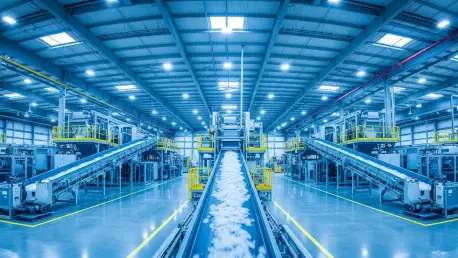
To remain competitive against cheap virgin plastic and imported materials, we are focusing heavily on operational efficiency and the installation of state-of-the-art equipment. We are planning significant investments in new machinery at the Vernon site to optimize the cleaning and sorting phases, which are the most cost-intensive parts of the process. By streamlining these workflows, we aim to hit an initial output of 45 million pounds of recycled PET while keeping overhead manageable. This scale allows us to buffer against market volatility because we are producing for our own internal demand, effectively insulating ourselves from the pricing swings that often sink independent recyclers. Success in this landscape requires a blend of high-volume throughput and a ruthless focus on lowering the per-pound cost of processed material.
Processing B-bales from mixed recycling bins is notoriously difficult compared to cleaner waste streams. Could you walk through the technical steps needed to refine these materials into food-grade pellets and explain how you plan to eventually scale up to a second production line?
Processing B-bales is a significant technical challenge because these compacted bundles from mixed recycling bins often contain higher levels of contaminants and non-PET materials. Our process begins with rigorous sorting and advanced washing to remove labels, adhesives, and debris, followed by grinding the plastic into small flakes. These flakes undergo a high-heat decontamination process to ensure they meet strict food-grade standards before being extruded into high-quality pellets. Being among the first to incorporate this specific B-bale processing into a bottling operation gives us a unique competitive edge in reclaiming “difficult” waste. Once we have optimized the first line and stabilized the output quality, we intend to scale up by adding a second recycling line to further increase our capacity.
With over half of California’s waste currently ending up in landfills, how does bringing 60 industrial jobs back to the Vernon area impact the local economy, and what specific steps are needed to ensure a steady supply of post-consumer PET from curbside programs?
Bringing 60 industrial jobs back to Vernon is about more than just numbers; it is about restoring a piece of the local manufacturing fabric that was lost when previous facilities shuttered. These jobs represent a revitalized commitment to the community and a direct investment in the green economy of Southern California. To ensure these workers have a steady supply of material, we rely on the fact that 95% of California residents have access to recycling programs, yet nearly 58% of waste still ends up in landfills. We need to bridge that gap by strengthening the infrastructure that moves PET from curbside bins to our facility, ensuring that the “momentum” of California’s recycling habits is translated into raw material. By providing a guaranteed destination for these containers, we help stabilize the local recycling ecosystem and keep valuable materials out of the dirt.
What is your forecast for the future of PET recycling in California?
The future of PET recycling in California is at a critical crossroads where industrial scale must meet environmental necessity. While the country has recently seen a 25% drop in PET recycling capacity, I believe the shift toward vertical integration—where companies like ours take direct responsibility for their packaging—will be the defining trend that saves the industry. We are going to see a transition from “feel-good labels” to tangible, massive investments in closed-loop systems that can survive even when virgin plastic prices are low. As we move forward, the success of the California circular economy will depend on our ability to turn billions of discarded containers into a reliable, high-quality resource. My forecast is that domestic, food-grade recycling will become the backbone of the manufacturing sector, driven by a combination of corporate accountability and a desperate need to reduce the 44 million tons of waste currently heading to our state’s landfills.