
Retaining the roofs and foundations of existing buildings avoids the massive carbon expenditure typically associated with new residential construction projects. In the current landscape of 2026, Australian architects are proving that net-zero living is not a future aspiration but a practical, attainable reality for modern homeowners. The Australian Institute of Architects recently conducted an extensive Zero Carbon Housing Challenge, which evaluated the environmental performance of over 330 residential projects. This initiative revealed that carbon-neutral homes are becoming increasingly mainstream, utilizing existing technologies to minimize their ecological footprint. By analyzing a diverse range of dwellings, from detached suburban houses to compact multi-unit townhouses, the study provided a comprehensive roadmap for the construction industry. These findings highlight that significant emissions reductions are possible when design priorities shift toward lifecycle sustainability rather than just focusing on immediate aesthetic appeal or initial build costs.
Sustainable Design Strategies for Modern Living
Optimizing Energy Performance in Single-Family and Multi-Unit Housing
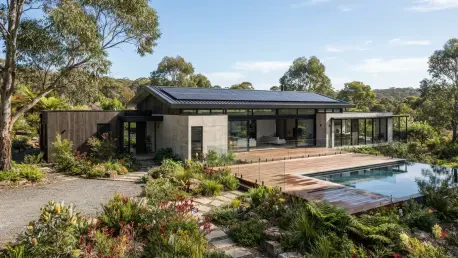
Single-family homes emerged as the current leaders in achieving net-zero status, primarily due to their expansive roof areas which facilitate large-scale solar energy generation. These dwellings often incorporate advanced photovoltaic systems and high-capacity battery storage, allowing them to produce more energy than they consume over the course of a year. Beyond energy production, superior energy efficiency plays a critical role in these successes, with architects focusing on high-performance glazing and optimized insulation to maximize natural heating and cooling. However, the study also emphasized that multi-unit developments, such as townhouses, hold immense potential for urban sustainability. By adopting compact, efficient floor plans and sharing structural walls, these projects significantly lower the per-resident carbon debt. The shift toward higher density did not compromise environmental goals; instead, it fostered innovative architectural solutions that balanced population growth with climate constraints.
Advancing Sustainability Through Strategic Renovation and Prefabrication
Industrial innovation and the strategic reuse of existing assets established a new benchmark for the global construction industry. The renovation of the Secret Garden House demonstrated that breathing new life into 1960s-era structures could yield lifetime emission reductions exceeding 90 percent. Architects successfully integrated high-performance thermal envelopes and natural ventilation systems into older frames, proving that the greenest buildings were often those already standing. Furthermore, the adoption of prefabricated, lightweight panels in Canberra halved upfront carbon costs, showcasing the power of factory-assembled precision. These advancements were mirrored in national policy as sustainable principles were woven into the National Housing Accord to target 1.2 million homes from 2026 to 2029. By standardizing these carbon-cutting techniques, the industry transformed energy-positive housing from a luxury into a mainstream requirement, ensuring that speed and sustainability remain compatible.
Establishing New Standards for a Carbon-Neutral Residential Future
The findings from the Zero Carbon Housing Challenge provided a clear framework for the immediate evolution of urban development. Industry leaders determined that the integration of solar technology and airtight construction was no longer optional but a fundamental requirement for economic and environmental survival. These developments were successfully implemented at scale, proving that net-zero goals were compatible with large-scale housing targets. Moving forward, the construction sector adopted a renovate-first mentality, ensuring that the existing building stock contributed to, rather than hindered, national climate objectives. By focusing on the full lifecycle of a home, architects and developers created a new paradigm where energy production became an inherent feature of the residential landscape. This shift secured a pathway where the built environment played an active role in ecological restoration, and investors prioritized properties that demonstrated long-term energy independence.