
Platinum-group metals remain the gold standard for water electrolysis, yet their extreme scarcity and high cost hinder the broad adoption of a hydrogen economy. In the current global energy landscape of 2026, the reliance on traditional fossil fuel reserves continues to dictate energy security and environmental policy, as approximately 85% of worldwide consumption remains tied to these finite resources. This persistent dependence has fueled a dual crisis involving the rapid depletion of natural assets and the continuous acceleration of greenhouse gas emissions. As societies pivot toward sustainable, net-zero alternatives, hydrogen has emerged as the premier energy carrier due to its incredible energy density and its remarkably clean combustion profile, which produces only water. However, the reality of the hydrogen market remains problematic, with over 99% of global production still derived from fossil feedstocks such as natural gas reforming and coal gasification. This discrepancy highlights the urgent need for scalable water electrolysis powered by renewable electricity, a process that requires the development of efficient, earth-abundant electrocatalysts to replace prohibitively expensive noble metals.
The Structural Potential: Biomass as a Carbon Platform
Biomass waste, sourced from diverse streams such as agricultural residues, forestry by-products, and municipal discharges, offers a revolutionary foundation for creating high-performance electrocatalysts. The primary advantage of this platform lies in its carbon-neutral lifecycle, which effectively offsets the carbon dioxide released during its processing through the natural absorption that occurred during the plant’s growth. Chemically, biomass is a sophisticated matrix primarily composed of lignin, cellulose, and hemicellulose, each playing a vital role in determining the structural integrity and surface characteristics of the resulting carbon scaffold. Lignin, a highly cross-linked aromatic polymer, provides the necessary carbon-dense framework that maintains structural stability during high-temperature thermal processing. By utilizing these naturally occurring materials, researchers can avoid the environmental and economic costs associated with synthetic carbon precursors, thereby aligning hydrogen production with the broader goals of a circular economy.
The thermal decomposition of these biomass components leads to the creation of a hierarchical pore architecture, which is essential for maximizing the efficiency of the hydrogen evolution reaction. This architecture typically consists of an interconnected network of micropores, mesopores, and macropores that drastically increase the electrochemically active surface area. Such structures are vital because they facilitate the rapid transport of electrolytes through the material while simultaneously ensuring the swift diffusion of ions and the release of gas bubbles during continuous water splitting. Without this complex porosity, catalysts often suffer from mass transport limitations that stifle reaction rates and reduce overall energy efficiency. The natural morphology of biomass, ranging from the fibrous textures of wood to the porous membranes of fruit peels, provides a template for these advanced networks that would be difficult and expensive to replicate through purely artificial synthesis methods.
Metal Integration: Overcoming Intrinsic Kinetic Barriers
While biomass-derived carbon provides an exceptional physical scaffold and high electrical conductivity, pure carbon frameworks often lack the specific electronic configuration required for high catalytic activity. To bridge this gap, researchers have turned to the integration of transition metals like nickel, cobalt, and iron into the carbon matrix to create powerful synergistic effects. These metals possess partially filled d-orbitals that are instrumental in lowering the energy barriers associated with water molecule dissociation, which is the foundational step in hydrogen production within alkaline environments. By embedding these metals at the atomic or nanoparticle level within the carbon lattice, scientists can optimize the binding energies for the adsorption and desorption of hydrogen atoms. This structural modification allows the composite material to achieve reaction kinetics that begin to rival those of platinum-group metals while remaining significantly more cost-effective for large-scale industrial applications.
The specific role of each metal within the carbon framework is often tailored to address different aspects of the electrochemical process. Iron frequently serves as an electronic promoter, modifying the local environment of neighboring active sites to enhance the overall reaction rate and long-term durability. In contrast, copper is often incorporated to bolster the electrical conductivity of the framework, ensuring that electrons move rapidly from the electrode to the active catalytic sites without significant resistive losses. Molybdenum species are also utilized to minimize the energy required to break oxygen-hydrogen bonds, particularly in harsh alkaline media. This multi-metal approach allows for the creation of sophisticated catalysts that handle the complex interplay of electron transfer and chemical bonding with high precision. The result is a robust material that maintains its performance even under the significant operational stresses of high-current density electrolysis.
Molecular Engineering: Heteroatom Doping and Advanced Compounds
Beyond the simple integration of transition metals, the performance of waste-derived catalysts is further refined through the process of heteroatom doping. This involves the strategic introduction of non-metallic elements such as nitrogen, sulfur, phosphorus, or boron into the carbon lattice to induce localized charge redistribution. Because these atoms possess different electronegativities compared to carbon, they create “polarized” sites that can more effectively bind reaction intermediates. The effectiveness of this doping process is highly sensitive to the specific bonding configuration and the concentration of the dopants within the lattice, with pyridinic nitrogen often identified as a key driver of catalytic efficiency. This molecular-level engineering allows for a more granular control over the catalyst’s behavior, enabling researchers to fine-tune the material for specific electrolyte conditions and temperature ranges, thus pushing the boundaries of what sustainable materials can achieve.
The integration of metals with specific anions has led to the development of advanced compounds like metal phosphides, sulfides, and carbides that offer unique advantages over simple oxides. Metal phosphides, for example, are known for their high electrical conductivity and a high density of active edge sites, which are particularly effective for hydrogen adsorption. Carbides and nitrides are prized for their exceptional chemical durability, allowing them to resist the corrosive nature of alkaline electrolytes over hundreds of hours of operation. Even metal oxides, which are typically less conductive on their own, become highly efficient when supported on a conductive biomass-carbon scaffold that neutralizes their electronic limitations. This combination of structural support and chemical diversification creates a versatile toolkit for hydrogen production, allowing for the design of catalysts that are not only efficient but also resilient enough for the demands of the modern energy grid.
Synthesis Pathways: Thermal and Chemical Activation Techniques
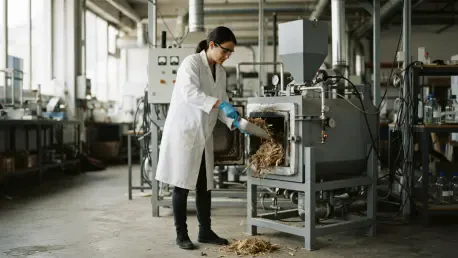
Converting raw biowaste into sophisticated electrocatalysts requires precise thermal interventions, with pyrolysis serving as the most common and scalable synthesis method. This process involves heating the biomass in an oxygen-free environment at temperatures typically ranging from 250 to 600 degrees Celsius to drive off volatile components and leave behind a carbon-rich residue. Technical precision is required during this phase, as the heating rate and the final temperature directly influence the degree of graphitization and the resulting conductivity of the material. Furthermore, feedstock preparation must be carefully managed, with specific particle sizes often required to ensure uniform carbonization within different reactor types, such as fluidized beds or rotating cones. This stage of production is critical for establishing the basic framework that will eventually support the active metal sites and determine the physical robustness of the final catalyst.
To further enhance the performance of these materials, chemical activation agents such as potassium hydroxide, zinc chloride, or phosphoric acid are often employed to “etch” the carbon structure. This chemical treatment dramatically increases the surface area by creating a vast network of internal pores, with some agricultural waste-derived carbons reaching surface areas exceeding 1,500 square meters per gram. Additionally, emerging techniques like microwave-assisted synthesis have gained popularity due to their energy-efficient nature and ability to provide volumetric heating. This method prevents the clumping of metal nanoparticles and significantly shortens the total reaction time from hours to mere minutes. By combining these chemical and thermal strategies, researchers can tailor the morphology of the catalyst to meet specific industrial requirements, ensuring that the resulting material is optimized for both high catalytic activity and rapid mass transport.
Performance Analysis: Evaluating Efficiency and Material Stability
The ultimate viability of a biomass-derived catalyst is determined through rigorous electrochemical testing, focusing on metrics such as overpotential, Tafel slope, and long-term stability. Overpotential represents the extra energy required beyond the theoretical limit to drive the hydrogen evolution reaction, and the benchmark for many researchers is to achieve a low overpotential at a current density of 10 mA/cm². The Tafel slope serves as an indicator of the reaction kinetics, where a smaller value signifies that the reaction rate increases rapidly with minimal increases in voltage. By using advanced characterization tools like X-Ray Diffraction and X-Ray Photoelectron Spectroscopy, scientists can correlate these performance metrics with the material’s crystalline structure and surface chemistry. These insights allow for the identification of the specific oxidation states and bonding environments that contribute most to the catalyst’s efficiency, providing a roadmap for further material optimization.
Durability remains one of the most significant challenges in the transition from laboratory research to industrial application. Modern biowaste-derived catalysts have demonstrated impressive stability in recent tests, with some materials maintaining consistent operation for over 90 hours without significant degradation in performance. This resilience is essential for industrial electrolyzers that must operate continuously under harsh conditions to be economically viable. Researchers track the structural changes in the catalyst during these long-term tests to ensure that the active metal sites do not leach into the electrolyte and that the carbon framework does not succumb to corrosion. The ability of these sustainable materials to withstand such operational stresses proves that biomass-derived solutions are not just academic curiosities but practical alternatives to precious metals. As stability testing extends into the thousands of hours, the confidence in these materials for grid-scale deployment continues to grow.
Future Implementation: Overcoming Barriers to Commercial Viability
The successful commercialization of biomass-derived catalysts required addressing several lingering technical and economic hurdles that initially limited their adoption. One primary concern involved the inherent heterogeneity of biomass feedstocks, where variations in mineral and lignin content between different waste batches led to unpredictable catalytic performance. This issue was largely managed through the development of standardized pretreatment protocols that homogenized the raw materials before carbonization. Furthermore, the industry focused on solving the problem of metal leaching and carbon corrosion at high current densities, which were critical for ensuring that industrial-scale electrolyzers remained operational over long lifecycles. By refining the encapsulation of metal nanoparticles within protective carbon layers, the structural integrity of these catalysts was significantly bolstered, allowing them to compete with traditional noble metal systems in terms of both longevity and reliability.
The economic profile of these sustainable catalysts was further enhanced through the integration of hybrid electrolysis and comprehensive life-cycle assessments. Instead of focusing solely on water splitting, some systems began replacing the energy-intensive oxygen evolution reaction with the oxidation of biomass molecules like glycerol, which simultaneously produced high-value chemicals and lowered the overall voltage required for hydrogen production. This dual-purpose approach drastically improved the techno-economic viability of the process, transforming waste management into a profitable chemical production stream. As the field matured, the energy costs associated with high-temperature pyrolysis were offset by the use of renewable energy and the development of more efficient microwave-assisted synthesis techniques. Ultimately, the transition to biomass-derived catalysts represented a fundamental shift toward a circular energy economy, where the valorization of discarded materials provided the essential components for a global hydrogen infrastructure.