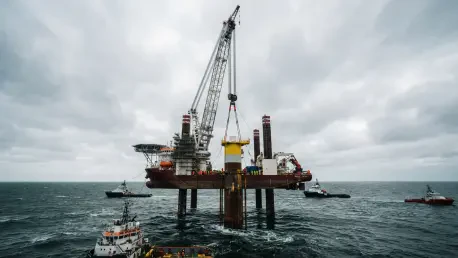

This recent incident underscores the challenges of managing seabed territory when direct-action conservation efforts overlap with major utility-scale wind developments. As the German energy giant RWE progresses with its ambitious offshore infrastructure plans, it finds itself navigating a landscape where environmental activism and renewable energy expansion occasionally collide. In a bold demonstration on October 31, the Greenpeace vessel Arctic Sunrise deployed nine massive stones, each weighing roughly two tons, within a 116-square-kilometer stretch of the Southern North Sea Marine Protected Area. This area is specifically designated for the Vanguard East wind-farm project. Greenpeace claims the move was necessary to halt bottom trawling, a practice they describe as detrimental to the delicate marine ecosystem. While the intention was to protect biodiversity, the placement occurred without official permits, creating a logistical puzzle for engineers tasked with ensuring the stability of subsea foundations for the upcoming clean energy transition.
Strategic Infrastructure Development and Environmental Coordination
The partnership between RWE and KKR recently reached a pivotal moment as they secured the necessary financial backing for the Norfolk Vanguard East and West developments. With a staggering investment of approximately twelve billion dollars, these projects are positioned as cornerstones of the UK’s strategy to achieve energy independence and carbon neutrality. Once fully operational, the sites will boast a collective capacity of nearly three gigawatts, providing power to millions of homes and businesses across the nation. This level of utility-scale development requires years of meticulous planning and precise execution to meet stringent regulatory standards. Although offshore construction is not scheduled to begin until early next year, the introduction of these boulders necessitates updates to the subsea surveys that commenced during the previous summer. RWE has engaged in constructive communication with Greenpeace to verify the exact coordinates of the stones, ensuring they are integrated into the logistical planning before mobilization.
From the perspective of the activists, the presence of nine additional boulders represents a negligible hurdle for a project of this magnitude and complexity. Greenpeace co-executive director Will McCallum argued that describing these stones as a significant threat to progress was essentially disconnected from the reality of offshore engineering. He noted that the North Sea seabed is already home to thousands of naturally occurring stones, many of which are significantly larger and heavier than those deployed by the activists. The original environmental impact statement submitted by the developers had already accounted for the clearing of numerous naturally occurring obstacles across the site. In comparison to the massive engineering challenges posed by shifting sands and existing geological features, the intentional placement of small stone clusters is seen as a minor inconvenience.
The resolution of this specific dispute demonstrated that maritime stakeholders benefited from increased transparency regarding seabed modifications. While the boulders were placed without formal consent, the subsequent coordination allowed engineers to plan for their relocation during the standard seabed preparation phase. Moving forward, developers realized that establishing clear communication channels with environmental groups helped prevent delays in commissioning vital clean energy assets. This incident proved that harmonizing the goals of nature conservation and green energy required a more integrated approach to marine spatial planning. It became evident that utility companies and non-governmental organizations needed to collaborate on shared ecological objectives to avoid future friction. By formalizing agreements on the protection of sensitive habitats during the early stages of infrastructure design, the industry ensured that large-scale wind projects remained compatible with biodiversity preservation. This proactive strategy ultimately facilitated a smoother transition.