
Tests conducted in Oregon and California with the Pacific Northwest National Laboratory confirmed that the blunt-blade runner is effective for larger species like American eels and rainbow trout. This finding represents a pivotal shift in a century-long struggle to balance renewable energy production with the preservation of vital river ecosystems. Historically, hydroelectric dams have stood as lethal obstacles for migratory species, often resulting in high mortality rates as fish attempt to navigate the spinning steel of underwater machinery. In the Northeast, specifically within the river systems of Maine, the decline of river herring has prompted urgent calls for technological intervention. The recent successful deployment of a novel turbine design at Freedom Falls on Sandy Stream demonstrates that engineering can indeed bridge the gap between industrial utility and ecological integrity. By reimagining the fundamental mechanics of water power, researchers have managed to achieve nearly total fish survival without compromising the output of the local power grid. This success provides a robust framework for future developments in low-impact hydropower, suggesting that the industry might finally move past the era where clean energy came at a heavy biological cost.
Innovative Engineering and Mechanical Design
Rethinking Blade Physics for Aquatic Safety
Traditional hydroelectric design has long been governed by the principles of high-velocity efficiency, which typically necessitates the use of thin, sharp-edged blades. These conventional propeller runners are engineered to slice through the water column with minimal drag, ensuring that the maximum amount of kinetic energy is converted into rotational force. However, what makes these machines efficient for power generation makes them inherently dangerous for aquatic life. When fish enter a standard turbine, they face multiple lethal risks, including direct strikes from the leading edges of the blades or being caught in the narrow pinch points between the spinning runner and the stationary housing. Furthermore, rapid pressure changes within the turbine chamber can cause internal injuries or disorientation, making the fish more vulnerable to predators once they exit the facility. For decades, these mechanical hazards were viewed as an unavoidable byproduct of large-scale renewable energy production, necessitating costly external mitigation measures that often failed to protect the most vulnerable species in the river.
Mechanical Design: Pinch-Point Reduction
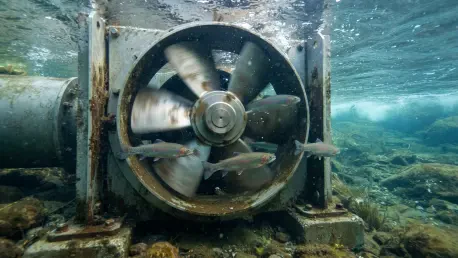
To solve this problem, a California-based engineering firm developed a fish-safe runner that fundamentally alters the physics of the encounter between fish and machinery. This innovative design replaces the numerous sharp blades found in traditional models with a smaller number of thick, blunt-edged components. These blades feature a distinct forward slant that extends from the central hub to the outer tip, creating a geometry that effectively guides fish through the water passage. Instead of suffering a sharp impact, a fish that comes into contact with the runner is gently nudged aside by the rounded surfaces. This mechanical cushioning effect allows the organism to ride the current through the turbine, significantly reducing the likelihood of mechanical injury. By minimizing the clearance between the runner and the housing, the design also eliminates the dangerous gaps where smaller fish were previously crushed, transforming the turbine from a hazard into a safe conduit. This evolution in runner geometry proves that even the most aggressive industrial processes can be refined to accommodate biological safety requirements.
The Freedom Falls Trial and Research Outcomes
Testing Vulnerable Species: Small-Scale Infrastructure
The real-world application of this blunt-blade technology took place at the Freedom Falls hydropower project, a site that reflects the scale and environmental challenges of many thousands of small dams throughout the United States. Researchers chose to focus on juvenile alewives because they are among the most sensitive migratory species in New England. Often referred to as alosines, these fish are notoriously fragile and prone to stress-induced mortality, making them an ideal benchmark for turbine safety. If a mechanical system can successfully pass a juvenile alewife without causing harm, it is highly probable that more resilient species like salmon or bass will also survive the journey. During the controlled trials, hundreds of these fish were released into the turbine intake under close observation. High-speed video cameras were mounted inside the housing to capture the precise moment of passage, providing engineers with invaluable data on how the fish interacted with the blunt blades and the surrounding water flow. This empirical approach allowed for a level of transparency and accuracy rarely seen in previous hydropower environmental assessments.
Statistical Outcomes: Green-on-Green Success
The statistical data gathered from the Freedom Falls study yielded results that outperformed nearly all previous benchmarks for hydropower safety. Initial assessments showed an immediate survival rate of 98.2 percent for the fish passing through the 1.8-foot diameter runner. Even more impressive was the corrected survival estimate after a 48-hour observation period, which reached a full 100 percent. To ensure the scientific validity of these findings, researchers compared the test subjects against a control group to account for any deaths caused by the stress of transportation and handling rather than the turbine itself. This level of success is particularly striking when compared to traditional hydropower plants, where juvenile fish survival can fluctuate wildly and sometimes drop as low as 34 percent. Achieving 100 percent survival in a functioning power generation unit validates the green-on-green philosophy, proving that technological innovation can eliminate the ecological trade-offs once thought to be a permanent feature of hydroelectricity. This data serves as a compelling argument for the widespread modernization of small-scale river infrastructure.
Economic Feasibility and Future Implementation
Reducing Costs: Inherently Safe Design
The shift toward inherently fish-safe turbines offers a compelling economic argument for dam owners who are currently facing mounting regulatory and maintenance costs. Traditionally, hydroelectric facilities have relied on secondary systems like fine-mesh screens and complex bypass pipes to divert fish away from the dangerous machinery of the turbine. While these auxiliary structures are necessary for compliance with environmental laws, they are notoriously expensive to install and require constant cleaning and repair to prevent clogging. Furthermore, even the best screens are not foolproof; small organisms can still become pinned against the mesh by the force of the water, leading to exhaustion or injury. By integrating fish safety directly into the core design of the turbine runner, operators can significantly reduce their reliance on these secondary systems. A turbine that acts as its own safe bypass simplifies the overall plant architecture, lowering the long-term operational expenses while ensuring a higher degree of compliance with modern environmental standards. This streamlined approach allows utilities to allocate resources more effectively toward long-term grid stability.
Overcoming Barriers: Habitat Challenges and Next Steps
It was equally important to acknowledge that while fish-safe turbines solved the immediate danger of mechanical strikes, they did not eliminate all the environmental impacts associated with river damming. Even with a safe passage route, a dam still functioned as a physical barrier that altered the natural flow, temperature, and sediment transport of a waterway. These changes disrupted the delicate balance of aquatic habitats and could still impede the ability of migratory species to reach their upstream spawning grounds. To truly modernize river management, the implementation of blunt-blade runners was integrated into a more holistic strategy that included the restoration of natural floodplains and the improvement of upstream passage facilities like fish ladders. Moving forward, the focus remained on optimizing the placement of these technologies within the larger river basin context. Success was measured not just by the survival of fish passing through a single turbine, but by the overall health and connectivity of the entire ecosystem. Actionable steps now include the development of a national database to track long-term recovery in these rivers.