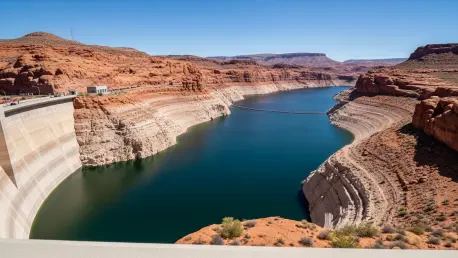

The Colorado River Basin currently sits at a precarious crossroads where the demands of forty million people clash with the harsh reality of a diminishing water supply that has supported life in the American West for generations. This vital artery, which winds through seven states and Mexico, provides the essential backbone for a massive agricultural industry and thirty tribal nations, yet its reservoirs are currently hovering at historic lows. The infrastructure of the West was built on the assumption of a much wetter climate than the one observed since the early 2000s, leading to a structural deficit that consumes more water than the sky provides. As the regional population continues to grow and industrial needs expand, the buffer once provided by Lake Mead and Lake Powell has nearly evaporated. Policy experts and hydrologists now suggest that the system is not merely in a drought but is undergoing a fundamental transformation that requires immediate intervention to prevent a total collapse.
The Aridification Trend: A Permanent Shift in Climate
Current scientific understanding has shifted away from the term “drought,” which implies a temporary period of dry weather followed by a return to normal, toward “aridification.” This process represents a permanent shift in the regional climate, characterized by rising temperatures that increase evaporation and reduce the efficiency of runoff from mountain snowpacks. In recent years, even when precipitation levels reached near-average figures, the thirsty soil and warmer atmosphere absorbed much of that moisture before it could reach the river’s main stem. This phenomenon creates a “ratcheting” effect where every dry cycle leaves the reservoirs in a significantly more vulnerable position than the one before it, and even exceptionally wet years provide only a fleeting respite. The math is simple and devastating: the basin is losing more water to the atmosphere and parched landscapes than it can afford to give, making the traditional management strategies of the 20th century obsolete.
Expert modeling reveals two potential paths for the river system, with one leading toward a catastrophic “dead pool” status at major dams. If the current dry trend persists through 2027 and beyond, reservoir levels at Lake Mead and Lake Powell could drop below the intake valves necessary for hydroelectric power generation. This would not only destabilize the regional energy grid but also force downstream users to rely on a “hand-to-mouth” delivery system where water is only available as it flows in real-time. While heavy snowpacks occasionally provide a temporary surplus, history suggests these gains are often squandered within twenty-four months due to high consumption rates and rapid evaporation. The structural integrity of the Glen Canyon and Hoover Dams was designed for a different era, and the prospect of these massive concrete giants becoming non-functional symbols of a drier age is now a distinct possibility that regional planners must confront with drastic new measures.
Socio-Economic Fallout: The Cost of Water Scarcity
The socio-economic consequences of a dwindling Colorado River are felt most acutely in the rural agricultural districts that provide a significant portion of the nation’s winter produce. As water allocations are cut, farmers are often forced to choose between fallowing their fields or selling their water rights to sprawling urban centers like Phoenix, Las Vegas, and Los Angeles. This transfer of water wealth from rural to urban areas threatens to dismantle the cultural and economic fabric of farming communities that have existed for over a century. Furthermore, as the price of water increases, the cost of food production rises, creating a ripple effect that impacts grocery prices and food security across the United States. The competition for every acre-foot of water creates a zero-sum game where the growth of metropolitan areas often comes at the direct expense of the region’s ability to feed itself, leading to a fragmented landscape where only the highest bidders can afford to survive the deepening crisis.
Politically, the seven basin states remain locked in a tense standoff over how to share the burden of necessary cuts, with consensus appearing increasingly out of reach as legal deadlines loom. While short-term “stop-gap” agreements reached between 2026 and 2028 have managed to stave off immediate federal intervention, these deals often fail to address the core issue of over-allocation. The 1922 Colorado River Compact was based on an unusually wet period, resulting in a legal framework that promises more water than the river actually carries. States are understandably protective of their historical allocations, yet the refusal to acknowledge the physical reality of the river’s decline leads toward a future defined by litigation rather than cooperation. Without a permanent and legally binding strategy to reduce the overall consumption footprint, the basin risks descending into a chaotic legal battle that could reach the Supreme Court, potentially upending a century of established water law and leaving the region’s future in the hands of the judiciary.
Management Reform: Planning for a Low-Flow Reality
A critical barrier to effective management is the reliance on federal projections that critics argue are rooted in an overly optimistic past rather than the harsh present. The Bureau of Reclamation has historically used long-term averages that include the abnormally wet mid-20th century, which tends to skew forecasts toward a higher flow than what is likely to occur under modern aridification. For the region to survive, water managers must shift their focus to the much lower inflow averages recorded between 2026 and the present day. Accurate data is the foundation of sound policy, and using outdated models creates a false sense of security that delays necessary conservation efforts. By acknowledging the trend toward extreme heat and reduced runoff, agencies can begin to build “stress-test” scenarios that prepare the system for the absolute worst-case outcomes. This shift requires a departure from bureaucratic inertia and a commitment to radical transparency regarding the actual volumes of water available for diversion.
Transitioning the West to a sustainable water future requires a reimagining of agricultural practices and the widespread adoption of advanced conservation technology. Financial incentives must be directed toward farmers who switch from thirsty crops like alfalfa and cotton to more drought-resilient varieties or high-value greenhouse operations. Simultaneously, the implementation of satellite-based remote sensing and high-precision flow meters across all sectors is essential for ensuring that every drop is accounted for and that no user exceeds their legal limit. Urban centers must also play their part by expanding wastewater recycling programs and eliminating non-functional turf, turning water conservation from a temporary emergency response into a permanent lifestyle. By investing in regional desalination projects and improving the efficiency of existing irrigation systems, the basin can begin to close the gap between supply and demand. This proactive framework moves the conversation toward a resilient, science-based model.
Future Resilience: Implementing Solutions for Sustainability
The path forward demanded a departure from the reactive policies of the past and a commitment to long-term structural reform across the entire Colorado River Basin. Lawmakers prioritized the development of a unified basin-wide management plan that replaced the fragmented, state-by-state approach with a coordinated strategy focused on total system health. Significant investments were made in regional water banks, which allowed communities to store surplus water underground during wet years for use during inevitable dry spells. Furthermore, the integration of tribal nations into the decision-making process proved essential, as their historical knowledge and senior water rights provided a foundation for more equitable distribution. By 2026, the shift toward market-based water transfers and enhanced atmospheric monitoring became the standard for precision management. These actions collectively moved the region toward a stable equilibrium, ensuring that the economy remained viable despite the challenges.
The widespread adoption of desalination and advanced water-recycling infrastructure effectively decoupled urban growth from the river’s dwindling natural flow. Local municipalities shifted their focus toward “one water” strategies, which treated stormwater, wastewater, and graywater as valuable assets rather than waste products to be discarded. This cultural transformation was bolstered by a significant overhaul of water law, which allowed for more flexible sharing arrangements during periods of extreme scarcity. By the time the next major heatwave arrived, the basin was better prepared to handle the stress without the immediate threat of system collapse. These collective measures demonstrated that while the river might never return to its former volume, a managed and sustainable future was possible through innovation and shared sacrifice. The resilience of the West ultimately depended on recognizing that the river’s limits were not just a suggestion but a physical reality that required a total commitment to stewardship.