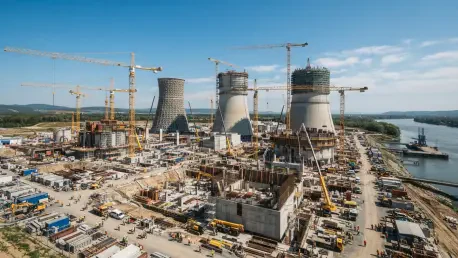

The expansion of the Haiyang site is a primary driver in China’s national goal to reach 200 million kilowatts of nuclear capacity by the year 2040. This ambitious trajectory was recently marked by a significant milestone at the Haiyang Nuclear Power Plant in Shandong province, where workers commenced the pouring of concrete for the nuclear island’s raft slab of Unit 5. This event officially signals the beginning of the project’s third phase, a critical step in transforming the facility into a massive energy powerhouse. As the energy landscape shifts toward carbon-free baseload power, the progress at Haiyang serves as a testament to the rapid industrial mobilization occurring within the region. The sheer scale of the construction involves sophisticated logistics and engineering precision, reflecting a broader commitment to securing energy independence while modernizing the power grid. By integrating advanced Generation III technologies, the site is positioned to redefine how major metropolitan hubs manage their power.
Safety Systems
Passive Tech
The technological heart of the Haiyang expansion lies in its utilization of passive pressurized water reactors, specifically the CAP1000 design which represents a localized evolution of global nuclear standards. These Generation III systems are engineered to enhance safety by leveraging natural physical laws, such as gravity and convection, to maintain cooling in the reactor core during unforeseen events. Unlike older designs that rely on complex arrays of pumps and external backup diesel generators, these passive mechanisms operate independently of active power sources, significantly reducing the risk of human error or mechanical failure during a crisis. This shift toward inherent safety protocols is a defining characteristic of the Phase III development, ensuring that the facility can withstand extreme scenarios without the need for immediate operator intervention. As construction progresses on Unit 5, the plant is poised to become one of the most resilient energy complexes in the entire world.
Power Testing
Parallel to the new construction, the site has recently seen the successful completion of hot functional tests for Unit 3, a rigorous verification process that ensures the entire system remains thermally and mechanically stable. These tests were conducted using non-radioactive heat sources, allowing engineers to validate the integrity of the coolant loops and secondary systems before any nuclear fuel is introduced to the reactor. Building upon these successful outcomes, technical optimizations have been implemented to increase the electrical rating of the newest units to approximately 1.3 million kilowatts each. This incremental increase in output is the result of refined turbine designs and improved thermal efficiency within the steam generators. Once the current expansion phase concludes, the combined six-unit complex will generate roughly 61 billion kilowatt-hours annually, sufficient to provide electricity for more than 54 million residents across the surrounding provinces and industrial zones.
Strategic Goals
Urban Heating
Beyond its role as a traditional electricity provider, the Haiyang facility is being transformed into a massive district heating hub that optimizes the use of thermal energy. By diverting steam from the secondary loop, the plant provides clean, carbon-free heat to residential and commercial sectors, replacing the need for local coal-fired boilers. This infrastructure currently serves five county-level cities, but future phases of the municipal grid expansion aim to cover an area of 150 million square meters across 25 different cities. Such large-scale heating solutions represent a significant shift in how utility management is approached in cold-climate regions, where heating demands historically contributed to seasonal air quality issues. The integration of nuclear heating reduces the reliance on fossil fuels for basic residential needs, creating a more sustainable urban ecosystem. This multi-purpose utility model demonstrates how nuclear assets can be leveraged for more than just the grid.
Policy Plans
The expansion at the Shandong site stood as a critical component of a national strategy to dominate the global energy sector through technical expertise and massive scaling. By late 2026, the progress on these reactors indicated that the nation remained on a clear path to surpass other major powers in operational nuclear capacity within the coming years. Policymakers utilized these developments to fulfill carbon neutrality pledges, aiming for nuclear power to constitute nearly a fifth of the total electricity supply. To maintain this momentum, stakeholders focused on deepening the integration of nuclear heating into broader urban planning while investing in the domestic supply chain for high-precision components. Future considerations for the industry included the standardization of reactor designs to shorten construction timelines and the expansion of desalination projects. These proactive steps ensured that nuclear energy remained a versatile tool for environmental preservation and economic growth across the landscape.