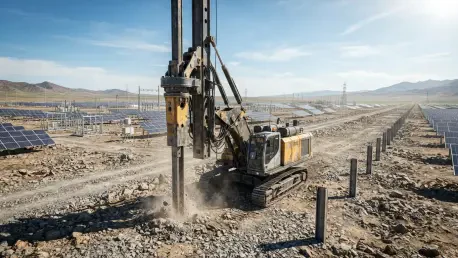

A single operator can now supervise a high-frequency hydraulic hammer as it autonomously navigates to precise coordinates on a vast construction site. This technological shift marks a pivotal moment for utility-scale solar farm and Battery Energy Storage System (BESS) development. As the global demand for renewable energy continues to surge to support power grids and energy-intensive AI data centers, the construction sector is grappling with a profound shortage of skilled heavy equipment operators. Traditional piling is a physically demanding and repetitive process that requires extreme precision to ensure that massive solar arrays remain stable for decades. The Xpanner X1 Piling R6 addresses these critical bottlenecks by automating the most labor-intensive aspects of site preparation. By replacing manual guiding with high-precision autonomous navigation, the system allows projects to move forward despite labor constraints. This transition from manual execution to digital supervision is redefining the benchmarks for speed and accuracy in large-scale infrastructure projects.
Mechanical Foundation: Engineering for Utility-Scale Success
Power and Stability: The Everstar R6 Crawler Base
Built upon the Everstar R6 crawler base, the X1 Piling R6 is engineered to handle the toughest terrain found on remote solar sites. A robust 130-hp engine provides the necessary torque and power to drive a high-frequency hydraulic hammer through various soil compositions, from soft clay to compacted earth. One of the most significant mechanical advantages is the 180-degree rotating upper body, which allows the machine to work on multiple piles within a single row without needing to reposition the entire crawler. This structural design ensures that the machine remains stable on uneven ground while providing the flexibility required for the complex layouts of modern utility-scale solar farms. By minimizing the time spent maneuvering the chassis, the robot maximizes the time spent on actual pile driving, effectively streamlining the most physically taxing parts of the installation.
This capability is complemented by a sliding guide rail that facilitates fine positioning, reducing the wear and tear typically associated with constant vehicle movement. The multi-function mast can accommodate various pile lengths, reaching up to 23 feet, which is essential for projects requiring deep stabilization or those located in flood-prone regions. Furthermore, the system can be reconfigured for pre-drilling or installing ground screws, allowing it to adapt to rocky soil where standard pile driving might be ineffective. This versatility means that a single unit can manage multiple stages of foundation work, reducing the need for specialized machinery on-site. The hydraulic system is optimized for high-frequency operation, which not only speeds up the installation process but also helps maintain the verticality of the piles during penetration, ensuring that every post meets strict load-bearing requirements.
Precision Control: Navigation and Integrated Data Systems
The autonomous capabilities of the X1 Piling R6 are driven by a sophisticated stack of precision sensors and high-precision GNSS antennas. These components allow the robot to pinpoint its exact location on a construction site with centimeter-level accuracy. Instead of relying on manual staking and string lines, the operator simply uploads a digital site plan into the proprietary automation controller. The robot then calculates the most efficient path to each coordinate, navigating the terrain with minimal human intervention. Once at the target location, the sensors monitor the angle and depth of the pile in real-time, ensuring that every post is driven to the exact engineering specifications. This level of precision is vital for solar trackers, which require perfectly aligned foundations to operate effectively. By removing the margin for human error, the system guarantees a higher quality of construction that impacts long-term reliability.
The integration of physical hardware with digital project management tools was a core achievement of the Xpanner ecosystem. Through the “Xpanner Connect” web-based dashboard, every action taken by the robot was logged and transmitted in real-time. This provided project managers with an immediate, data-driven view of construction progress, including the exact position and depth of every pile. To capitalize on these advancements, firms began adopting “Construction as a Service” models to maintain financial flexibility across various project phases. Developers were encouraged to integrate these robotic solutions early in the planning phase to maximize their impact on project timelines and labor costs. This shift toward a fully autonomous workflow, utilizing tandem robots for both piling and panel installation, successfully reduced reliance on large crews while maintaining the high standards required for modern energy grids.